



FOR ADSENSE AND AD MANAGER PUBLISHERS
Google-certified CMP: stay eligible for personalized ads in Europe.
Google requires publishers to use a certified consent management platform (CMP) to serve personalized ads to visitors in the EEA and the UK, and in Switzerland. ConsentBit is on Google’s certified CMP list for websites, so the consent your visitors give can unlock personalized ads.
Google-certified CMP · IAB Europe registered CMP (ID 502) · TCF v2.3
Listed by Google as a certified CMP for the web, TCF CMP ID 502.
Visitors choose purposes and vendors. Google’s ad tags read the result.
Google’s rule for publishers, not a law.
The requirement comes from Google. It covers publishers who use Google AdSense, Google Ad Manager or AdMob with visitors in the EEA, the UK or Switzerland. A certified CMP must be integrated with the IAB Transparency & Consent Framework (TCF), and Google recertifies CMPs at least every 12 months.
Without a certified CMP
No personalized ads
Traffic from a non-certified CMP may only get non-personalized or limited ads, where Google supports them.
Required since
16 January 2024 (EEA and UK) · 31 July 2024 (Switzerland)
ConsentBit
Google-certified for websites · IAB Europe CMP ID 502
Five things Google requires for personalized ads in Europe
Each requirement in plain terms, next to how ConsentBit covers it.
How a visitor’s choice reaches Google’s ads
The TCF turns one visitor’s choice into a signal every ad vendor on the page can read.
A visitor from Europe lands
ConsentBit shows the TCF banner, with the standard purposes and your list of vendors.
They make a choice
They decide which purposes and which vendors to allow.
The choice becomes a TC string
ConsentBit stores it in the browser as a coded consent record.
Google decides which ads can serve
Google’s ad tags read the string and serve personalized, non-personalized or limited ads to match.
The same purposes on every site. Google needs a few of them.
The TCF uses 11 standard purposes, so every ad vendor reads consent the same way. For personalized ads, Google looks for consent to purposes 1, 3 and 4.
Purposes and vendors
What Google can serve, based on consent
Google reads the TC string on each page and decides which kind of ad it’s allowed to show.
For personalized and non-personalized ads, Google also needs purposes 2, 7, 9 and 10 to be allowed.
What limited ads are
Limited ads don’t use cookies or other local storage and aren’t personalized. Google uses them when a visitor hasn’t agreed to storing information on their device.
Consent Mode follows too
ConsentBit passes the visitor’s TCF choice on to Google Consent Mode, so Google Analytics and Google Ads tags follow the same decision.
New to the framework? See how IAB TCF works in ConsentBit →
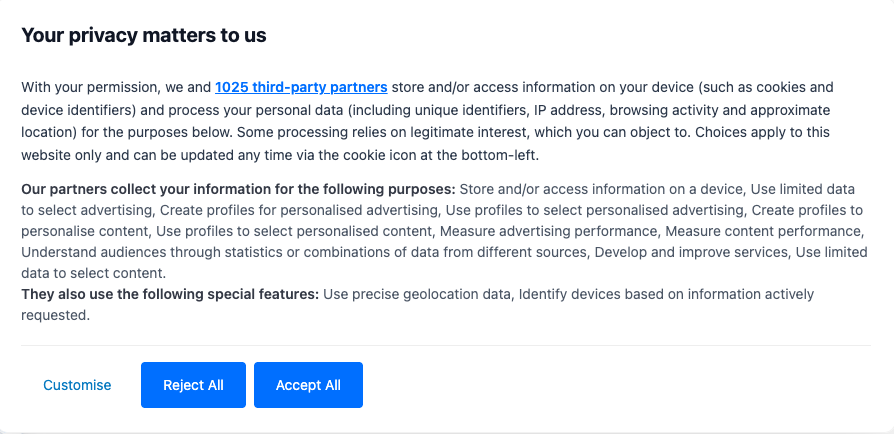
Try ConsentBit’s TCF banner on your site.
On Google’s list. Check it yourself.
Google publishes the CMPs it has certified and updates the list weekly. IAB Europe publishes its list of registered CMPs too.
FAQ
Google-certified CMP questions, answered
Short answers to what publishers ask most.
Do I need a Google-certified CMP?
You need one if you show ads through Google AdSense, Google Ad Manager or AdMob and want to serve personalized ads to visitors in the EEA, the UK or Switzerland. If you don't show Google ads, or don't have visitors from those regions, this requirement doesn't affect you.
What happens if my CMP isn't certified?
Google says traffic from a non-certified CMP may only be eligible for non-personalized or limited ads, where supported. Your ads can still run, but without personalization, which can lower your ad revenue.
Does a Google-certified CMP make my site GDPR compliant?
Not on its own. Google assesses certified CMPs against criteria focused on the TCF, and says it doesn't check them for full compliance with the TCF or privacy laws. Your site still has to meet GDPR, for example by getting consent before non-essential cookies run.
(Link: "See what GDPR requires")
Do advertisers need a Google-certified CMP?
The certified CMP requirement is for publishers who show ads. Advertisers who run Google Ads campaigns or use Google Analytics need to send consent signals through Google Consent Mode V2 instead.
(Link: "How Google Consent Mode V2 works")
What's the difference between a Google-certified CMP and IAB TCF?
IAB TCF is the ad industry's framework for collecting consent and sharing it with ad vendors, and a CMP has to register with IAB Europe to use it. Google certification is a separate review by Google, on top of that registration, for CMPs used with AdSense, Ad Manager and AdMob. ConsentBit has both.
(Link: "IAB TCF")
What changed with TCF v2.3?
Since 28 February 2026, new TCF consent strings must include a "disclosed vendors" section that shows which vendors the visitor was actually shown. Google treats new strings without it as invalid, so those ad requests can fall back to limited ads. Strings created before that date stay valid. ConsentBit generates v2.3 strings.
Does ConsentBit work for mobile apps that use AdMob?
ConsentBit is certified by Google for websites. If you show ads inside a mobile app through AdMob, you'll need a CMP that Google has certified for apps.
Is there a free trial?
Yes. IAB TCF support starts on the Essential plan, and every paid plan comes with a 14-day free trial. See pricing for what each plan includes.
(Link: "See pricing")
Related reading
Stay eligible for personalized ads in Europe
Collect TCF consent with a Google-certified CMP, pass it to Google and your other ad vendors, and keep your consent strings up to date with TCF v2.3.