

Drupal Cookie Consent: Which Module, and When a Module Is Not Enough
Drupal has no shortage of consent modules. Klaro, COOKiES and EU Cookie Compliance all put a banner on your site, all are free, and all are maintained by people doing good work.
What none of them do is scan your site for the trackers your modules and embeds added last quarter, keep an exportable consent record across every site in your estate, or send consent signals to Google.
ConsentBit is a Google-certified CMP that runs on Drupal from a single script.
Consent, Done Better.
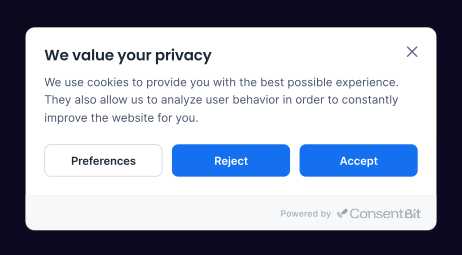
A banner is not consent
A banner announces cookies. Consent means nothing non-essential runs until the visitor agrees.
On Drupal the gap usually opens somewhere between the theme and the module list. Google Analytics arrives through a module, a map or video embed arrives in a text field, a marketing tag arrives through Google Tag Manager, and the banner that was configured two years ago knows about none of them.
The Drupal consent options, compared
Three modules do most of this work on Drupal. Klaro is the one chosen for Drupal CMS, and the other two point to it
Checked on 23 November 2026 against each module's drupal.org project page. Where a project page does not state a capability, we show it as not stated rather than claiming it is missing. CookieConsent is not included: it reports 692 sites and has no supported stable release.
Klaro is a capable piece of software and is the Drupal community's choice, so if you want a free module, start there. Two things it does not do are find your cookies for you and keep an exportable consent record, which is the gap a CMP fills. EU Cookie Compliance is the one to be careful with. It is on the most sites by far, and its own project page says it "can only prevent cookies from being set on the current site. External JavaScripts will still be able to set cookies."
Four questions that decide it
How to add cookie consent to a Drupal site
Scan your site
Add your domain and ConsentBit returns every cookie and tracker found, including the ones your modules and embeds brought with them.
Add the script
Install the Asset Injector module, then go to Configuration → Development → Asset Injector → JS Injector, paste the ConsentBit script and apply it to all pages. If you prefer to work in the theme, add it to html.html.twig before the closing head tag.
Set your rules and publish
Choose your categories, style the banner, set your regions, publish. Non-essential scripts stay silent until consent.
How to check your Drupal site actually blocks cookies
Two minutes, no tooling beyond the browser.
Illustration of the test result. Cookie names are the examples from step 3.
Found cookies firing early?
Run a free scan and see every tracker on your site in under a minute.
What changes once ConsentBit is on
Nothing tracks before it should.
Analytics, tags, embeds and third-party widgets stay off until the visitor chooses.
Your cookie list stays current.
Automatic scanning catches what was added since the last review, instead of waiting for an audit to find it.
Proof, not promises.
Every consent is logged with its timestamp and choices, and exports as CSV or JSON.
One tool across the estate.
The same account covers Drupal, WordPress, Webflow, Framer, Shopify, Squarespace, Wix, Magento, Joomla and anything else where you can add a script.
- Free · 1 domain, 5,000 pageviews
- Basic $9 · per domain, per month
- Essential $20 · adds IAB TCF
- Growth $56 · adds geo rules and white label
Annual billing saves 12.5% to 33%. 14 day trial, no card required.
ConsentBit for Drupal at a glance
Built for how Drupal sites get run
Universities and public bodies.
Dozens of sites, several teams adding tracking, one compliance officer who will eventually ask for evidence.
Agencies with Drupal clients.
One dashboard across every client, on Drupal and on whatever else they build.
Publishers.
IAB TCF v2.3 on Essential and Growth, for sites selling programmatic advertising.
Four mistakes we see on Drupal sites
The banner configured at launch.
Modules and embeds have been added since, and none of them are in the cookie list.
Analytics loading from the theme.
Anything hardcoded into the template fires regardless of what the banner says.
A module that stopped being maintained.
EU Cookie Compliance runs on 66,000 sites and is now marked on drupal.org as replaced by Klaro. Major version upgrades leave consent broken until someone notices.
No consent records.
A banner proves you asked. An export proves they answered.
Frequently asked questions
For a single site, Klaro is the strongest free option and is the module chosen for Drupal CMS. The reason to use a CMP instead is automatic scanning, exportable consent records, IAB TCF and managing several sites from one place.
For a single site with a short tracker list, the free modules do the job. The reason to use a CMP instead is automatic scanning, exportable consent records, Consent Mode v2 and managing several sites from one place.
Install the Asset Injector module, paste the ConsentBit script into a JS injector applied to all pages, then set your categories and publish. You can also add it to the theme template.
Yes. ConsentBit runs as a script, so there is no module to keep compatible through major version upgrades.
Yes. Scripts stay blocked until consent, and Google Consent Mode v2 is included on every plan.
Plans start at $9 a month per domain for Basic. Essential is $20 and Growth is $56, with annual billing saving between 12.5% and 33%.
Yes. One domain, 5,000 pageviews a month, with GDPR and CCPA coverage, automatic script blocking and Google Consent Mode v2 included.
Yes. Every site gets its own banner and settings, managed from one dashboard, with volume discounts from 30% off at five domains.
Drupal, WordPress, Webflow, Framer, Shopify, Squarespace, Wix, Magento, Joomla, plain HTML and any site where you can add a script.
Yes. Consent records export as CSV or JSON, with timestamps and the exact choices made.
Scan. Block. Prove.
Consent, Done Better.
One script, every site in the estate.