



Squarespace has a cookie banner. It does not have cookie consent.
Switch on the Squarespace banner and it will tell visitors you use cookies. What it will not do is stop the Google Analytics, Meta Pixel or booking widget you pasted into Code Injection from firing before anyone clicks a thing.
ConsentBit closes that gap in about ten minutes, through the same Code Injection panel. Scan your site, block what should be blocked, keep the record that proves it.
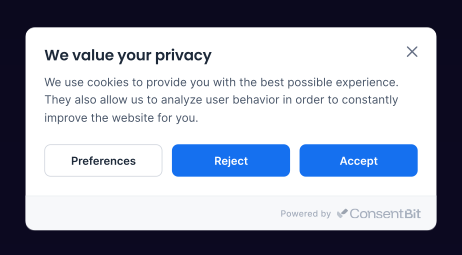
A banner is not consent
A banner announces cookies. Consent means nothing non-essential runs until the visitor agrees.
Squarespace built you the first part. The second part depends on something it cannot do, because Squarespace has no consent API of its own. Any script you add through Code Injection runs on its own schedule, and the banner has no way to hold it back.
So on a plain Squarespace site with nothing added, the built-in banner may be all you need. The moment you paste in a tracking script, the picture changes.
What the built-in banner covers, and where it stops
Four questions that decide it
How to add cookie consent to Squarespace
Adding ConsentBit to Squarespace takes one script and no app or plugin.
Scan your site
Add your domain and ConsentBit returns every cookie and tracker found, including the ones your embeds brought with them. You start from a list instead of a guess.
Paste the script
In Squarespace, open Settings → Developer Tools → Code Injection, paste the ConsentBit script into the Header field, and save. Code Injection is available on Business plans and above.
Set your rules and publish
Choose categories, style the banner to match your template, set your regions, publish. Scripts stay silent until someone agrees.
The script is lightweight and loads asynchronously, so your pages render as fast as they did before. Blocking trackers until consent often makes that first load lighter, not heavier.
Then turn the Squarespace banner off. Two banners asking the same question is worse than one.
How to check your site actually blocks cookies
Do not take the banner's word for it. This takes two minutes.
Most Squarespace sites running only the built-in banner fail step 3. That screenshot is the whole problem in one image, and it is worth taking before you change anything, so you can compare afterwards.
Run it again every time you add an embed.
Illustration of the test result. Cookie names are the examples from step 3.
What changes once ConsentBit is on
Nothing tracks before it should.
Analytics, pixels, chat widgets and embeds stay off until the visitor chooses. That is the part regulators actually care about.
You can answer the question “prove it”.
Every consent is logged with its timestamp and choices, and exports as CSV or JSON whenever you need it.
Your banner looks like your site.
Full design control on every plan, with translations you can add for the languages your audience uses.
Your other sites come along.
The same account covers WordPress, Webflow, Framer, Shopify, Wix, Magento, Drupal, Joomla and anything else where you can add a script. For a studio running client sites across platforms, that is one tool instead of four.
Free plan available, and every paid plan comes with a 14-day trial and no card required.
Built for how Squarespace sites get used
Designers and studios
Client sites rarely all sit on one platform. One account, one set of banner settings, and every site managed from the same dashboard.
Service businesses
Calendly, chat widgets and booking embeds each set cookies. Automatic scanning finds them, blocking holds them.
Shops and course sellers
If there is a pixel on the site, there is an ad budget behind it, and Consent Mode v2 keeps that measurable after someone declines.
Frequently asked questions
Yes. Squarespace has a built-in cookie banner with Accept, Decline and Manage options that covers Squarespace’s own cookies. It has no way to hold back scripts you add through Code Injection.
On a plain site with nothing added, it may be all you need. Once you paste a tracking script into Code Injection, that script can fire before anyone clicks, which is the part consent rules care about. Run the two-minute test above to check.
Open Settings → Developer Tools → Code Injection, paste the ConsentBit script into the Header field, and save. Then turn the built-in Squarespace banner off.
Code Injection is available on Squarespace Business plans and above, and that is where the ConsentBit script goes.
You can, but you should not. Two banners asking the same question is worse than one, so turn the Squarespace banner off once ConsentBit is live.
The script is lightweight and loads asynchronously, so your pages render as fast as they did before. Blocking trackers until consent often makes that first load lighter, not heavier.
Squarespace, WordPress, Webflow, Framer, Shopify, Wix, Magento, Drupal, Joomla and anything else where you can add a script. One account covers them all.
Yes. Every consent is logged with its timestamp and choices, and exports as CSV or JSON whenever you need it.