




Subscribe to ConsentBit Newsletter
Cookie
07 Best Cookiebot Alternatives for 2026

26
June
2026
29
June
2026
TL;DR
Before we dive into the details, here is a quick summary of what we cover in this blog.
- Most Suitable Alternative: ConsentBit is the best cookie compliance tool that is simple, easy to use, and lightweight. It comes with native Google Consent Mode v3 integration, which makes it the top-rated choice for most businesses.
- Best for Enterprises: OneTrust is a power-packed solution with a full set of features for larger businesses. The pricing is on the high end.
- Best for SMEs: Considering the simple and easy-to-use interface, CookieYes is well suited for startups and small businesses.
- Key Takeaway: Even though Cookiebot stands as a leading star in the competitive market, more and more businesses are moving to better cookie consent alternatives like ConsentBit. Reports say that this is mostly to avoid page count pricing traps as well as to improve their Core Web Vitals scores.
When we talk about cookie consent management, there are quite a number of tools that come into our minds. Among these, CookieBot is a popular tool that helps websites to inform users about how their data is tracked, obtained, and managed. These tools, however helpful, are chosen by various users based on many factors, including trust, regulatory compliance, preference management, transparency, pricing structure, legal protection, performance, and more.
As the online footprints are getting bigger, people, including business owners, website managers, developers, compliance officers, etc., are looking forward to finding better alternatives to CookieBot. But the requirements can vary based on the niche and sector you focus on. So how to choose the right cookie app? Worry not; we have compiled a quick list to help you better understand your specific needs and choose the best cookie app that actually works for you. Let’s begin.
Comparison Table: A Quick Overview
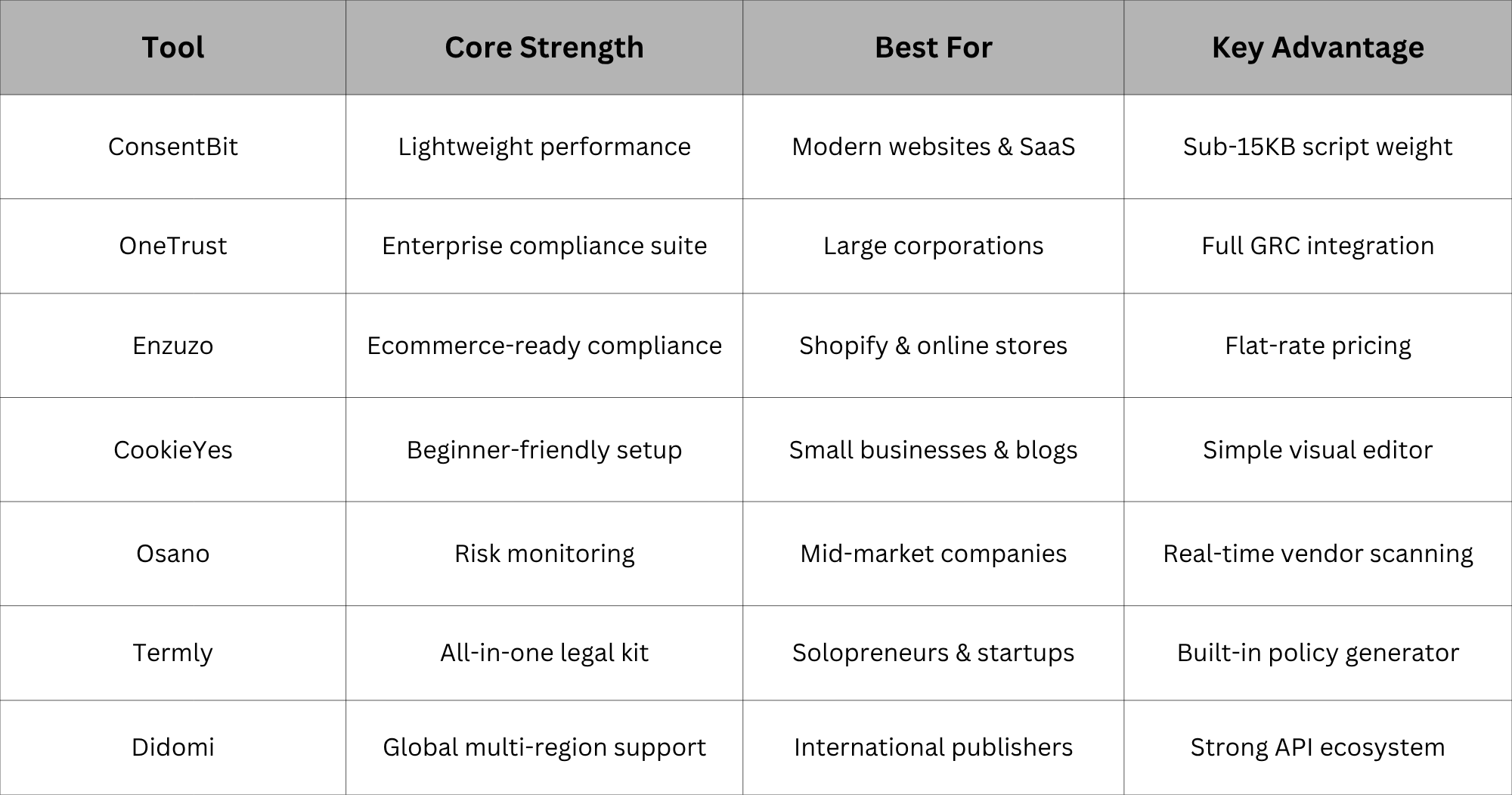
Here is a quick table that shows the core strengths and main advantages of the most popular cookie consent management tools:
Why Should You Switch from Cookiebot in 2026?
There are many reasons that necessitate businesses to search for better cookie apps and consent management tools. One of the most important reasons is the growing needs of the market place, where businesses are required to navigate more strictly.
Considering the growing needs of the marketplace, more businesses these days are in search of better cookie apps and consent management tools. This is primarily to navigate the stricter regulatory compliance and legal risks associated with the use of user data.
To start with, since Cookiebot became part of the Usercentrics family, its evolution has changed how it is used, attracting new capabilities along with new price points, new product direction, and a different support structure (for those who have used it previously), and therefore rendering the platform more cumbersome and unpredictable than before.
The pricing model by subpage could present a huge concern for you as your site continues to grow. The one thing that can drive up your costs quickly is adding additional pages to your site and/or parent pages with multiple subpages. For example, if you were to have an eCommerce site that has a large number of products, or if you have a content-heavy blog that is published frequently, or if you have a SaaS platform that creates multiple pages dynamically or programmatically, each of these page types could substantially increase your compliance costs.
Those costs can become volatile and unmanageable, especially for fast-growing businesses.
In 2026 there will be much greater scrutiny of performance as a result of search engines focusing on core web vitals. Therefore, website speed and responsiveness will have a tremendous impact on your rankings. Each heavy consent script added to a page will add to the page load times of that page and will create negative impacts on your Total Blocking Time (TBT) and/or Largest Content Paint (LCP) metrics. Thus jeopardizing not only your SEO but also potentially harming your user's engagement levels and ultimately your conversion rates.
Likewise, users also expect a fast and seamless browsing experience. Even slight lags due to slow and bulky scripts can lead to a larger number of people bouncing from the site and losing out on conversion opportunities. Because of this, businesses are seeking a new consent management platform that are
- Lightweight and loading fast
- Built with API-first architecture
- Built to scale
- Completely compatible with Google’s consent mode v3.
In addition to traditional management tools being transitioned to these modern platforms, newer offerings also provide greater automation, better user interfaces, and more flexible pricing models, which makes them an excellent choice for small to medium-sized businesses as well as large enterprises.
All of the options available in this guide are specifically chosen based on the performance of each choice; the compliance features offered for each option; the ease of use of each product; and the overall return on investment. Every tool listed here offers a faster and more scalable way to manage user consent in a very sensitive online environment.
Which Are the Top 7 CookieBot Alternatives?
Here is a curated list of the best CookieBot alternatives you can try in 2026. We have made this choice, helping our valued readers understand the value proposition, main features, user ratings, and other important information.
1. ConsentBit (Our Top Pick)
ConsentBit has established itself to be the most performance-focused consent management system of 2026. This strength in performance was a primary component of what placed ConsentBit on top of the leaderboard for our 2026 CMP rankings.
- Google Ratings Section: On G2, ConsentBit currently has an average score of 4.8 out of 5. Capterra reviewers have rated the app 4.7 out of 5 and this is particularly considering the ease of implementation.
- What They Offer: The platform supports multi-language banners and also offers automatic cookie scanning, native Google Consent Mode v3 integration, geo-fencing for region-specific compliance, granular consent categorization, and a robust audit log for accountability purposes.
- Why We Picked Them: The banner script weighs less than 15KB when minified and gzipped. This is much smaller than most competitors in this category.
2. OneTrust
OneTrust is one of the best choices for enterprise organizations. More than just giving out what the usual cookie consent apps do, they work as a complete governance, risk and compliance platform. Also, their consent module integrates with vendor management and policy management tools.
- Google Ratings: As of the G2 OneTrust rating, it is approximately 4.4 out of 5 stars. The Capterra reviewers' rating in 2026 is about 4.7 out of 5 stars. All these ratings consistently speak to the comprehensive set of features that OneTrust provides.
- What They Offer: Deep auto-scanning, Google Consent Mode v3 support, tag manager integration (including all major players), multilingual banners, and legal/compliance reporting content.
- Why We Picked Them: OneTrust is best known for its compliance all-in-one capabilities that allow for management of multiple privacy compliance requirements across all relevant jurisdictions at the same time, which is particularly helpful for large organizations with global footprints.
3. Enzuzo
Enzuzo has become a favorite amongst e-commerce store owners, especially those on the Shopify platform. For a flat fee, you get all the compliance features Enzuzo offers, without the variable costs per page seen with Cookiebot’s plugin. Easy to budget for, shop owners love the ease of installing and getting started with Enzuzo.
- Google Ratings: Our G2 rating is 4.7 out of 5 stars, and our Capterra rating is 4.6 out of 5 stars. We have many reviews that highlight how easy our software is to set up.
- What They Offer: This privacy and data protection solution includes a fully customizable consent banner and automatically generated privacy policy. It also processes data subject requests, includes geo-targeting, and can easily integrate with Shopify, WooCommerce, and other major e-commerce platforms.
- Why We Picked Them: Enzuzo goes beyond simple privacy policy templates. Their service generates privacy and terms-of-use policies based on the integrations that you have active on your store. This feature prevents you from generating policies that are not up to date or relevant.
4. CookieYes
CookieYes is particularly useful for small website owners, small businesses, bloggers, and single domain name owners who require an easy-to-use solution. CookieYes has a user-friendly interface and easy-to-understand documentation written in simple language that doesn't confuse ordinary internet users.
Google Ratings Section: Our G2 page shows a rating of 4.6/5 stars from last week's reviews on G2. Our Capterra page is currently rated 4.5/5 (2026 reviews).
What They Offer: This solution remembers cookies automatically, blocks prior third-party cookies, supports Google Consent Mode v3, and reminds users in 31 languages. It also comes with a free plan designed for tiny sites.
Why We Picked Them: CookieYes offers a genuinely useful free plan with reasonable limits, allowing for full testing before you spend a dime.
5. Osano
Most solutions tackle the consent collection and consent removal tasks; Osano, on the other hand, focuses on the consent monitoring / consent risk task, which is why it’s a particularly good fit for mid-sized organizations looking for ongoing monitoring and not just a set-it-and-forget-about data access banner. We actively monitor every vendor for changes to how they treat your data.
- Google Ratings Section: Users agree that Osano has received glowing reviews through industry ratings. It currently holds a G2 score of 4.6 out of 5 and a Capterra rating of 4.5 out of 5.
- What They Offer: The software includes additional features such as full consent management, vendor risk scoring, and data mapping and the company’s proprietary “no fines, no penalties” warranty.
- Why We Picked Them: Osano utilizes data from its vendor risk database to determine which vendors are loading code onto a given site and offers tools beyond vendor banners to fix the root cause of the issue.
6. Termly
Termly is not just a tool for generating and managing boilerplate consent banners; it is an all-in-one legal solution for privacy policies, terms of service, and more, making it especially valuable to solopreneurs, small businesses, and startups.
- Google Ratings Section: Termly has a 4.5 out of 5 stars G2 rating and 4.6 out of 5 stars. Capterra rating.
- What They Offer: The platform includes a consent banner, automatic policy generation for several legal documents, regional compliance support for GDPR, CCPA, and other legal frameworks, and an intuitive dashboard suitable for non-technical users.
- Why We Picked Them: Termly’s policy generator includes the latest laws and is updated for you, so small business owners without in-house counsel don’t have to spend hours researching and writing laws for their company.
7. Didomi
Didomi has built a strong following among international publishers and media companies, and its global compliance coverage is among the most comprehensive in the category. The platform supports a wide range of regional regulations and offers a flexible API that suits sophisticated technical teams.
- Google Ratings Section: On G2, Didomi holds a rating of 4.5 out of 5, while Capterra reviewers give it a score of 4.4 out of 5.
- What They Offer: Didomi provides cross-device consent synchronization, multi-jurisdictional templates, an extensive API ecosystem, integrations with major advertising platforms, and detailed analytics on consent behavior.
- Why We Picked Them: Didomi's API-first approach makes it especially well-suited for teams that want to build custom consent experiences rather than rely solely on prebuilt banner templates.
Key Factors to Consider When Choosing an Alternative
Before jumping to any cookie apps, there are some important factors to be considered. A few of them are:
- Tool Pricing: Look for pricing that scales with the number of domains, subpages, and monthly sessions. It may seem cheap at first, but prices can skyrocket as your website grows. Compare these costs against your expected traffic and growth.
- Google Consent Mode v3: Integrating your platform with Google tags is a critical process to ensure that you preserve conversion measurement and audience signals while users exercise control over data privacy options. Ensure that the platform is an authorized Google CMP (Consent Management Platform) partner and also supports Consent Mode v3 as declared in this document.
- First-Party Data Strategy: Most tools do more than just anonymous cookie blocking and actively help you collect and utilize first-party data by generating timely and relevant consent triggers. This helps maximize the rate of informed opt-in from your users.
- Auto-blocking Accuracy: Most apps do not have this feature. This feature, more than just blocking traditional cookies, also looks into pixels, beacons, and any other 2026 fingerprinting scripts.
Why Webflow and Modern Frameworks Prefer These Alternatives
Web development has come a long way in the last few years, and the current preferred method of teams working with popular CMS like Webflow, Next.js, Astro, and more involves lightweight, API-focused solutions for handling user consent.
Unlike older methods for achieving the same goal, modern solutions don’t require plugins. Traditional consent solutions have a common problem: they synchronously include a lot of extra JavaScript, which hinders page load and extends the time before the first interaction.
Modern alternatives to date have much simpler APIs that can be tailored to suit the existing design systems, loaded asynchronously, and only initialized on the client where necessary. This approach saves you from adding unnecessary long-term technical debt by saving you from having to manage and test another third-party script.
For websites built as component-based applications, this approach is particularly useful, as consent handling can now be embedded directly into individual components instead of being bolted on to the pages as an afterthought. This results in saving time to market for future launches.
How We Evaluated These Alternatives
The 7 best CookieBot alternatives listed above were evaluated considering both qualitative and quantitative criteria.
We evaluated each of the tools listed above by comparing the Lighthouse performance scores before and after the cookie banner installation. We also noted the banner script size, time taken for execution, performance levels, and more to understand it on a technical side.
But we know understanding just the technical aspects is not enough when it comes to cookie consent apps and management software. The privacy regulations and other factors should not be overlooked. So we also examined how each tool addressed various regulatory compliance laws like GPPR, CCPA, Quebec’s Law 25, and other regional frameworks. Apart from these, we also review client testimonials to understand real user experiences rather than looking at the marketing claims.
Conclusion
With a wide range of cookie consent management tools and software available in the market, it’s true that businesses may feel confused about which type of tools they should use for getting the best results.
For most modern websites, the choices are in understanding the business requirements; the type and size of business, whether small, medium, or large or enterprise; the complexity of compliance requirements; and other performance factors.
OneTrust is the most suitable model for large-scale businesses and enterprises. Ecommerce businesses can switch to Enzuzo. Those looking to add value to their small businesses can try CookieYes.
But if you are still looking for some better alternatives that won't exceed your budget but offer better results, you can definitely try out ConsentBit. It is a simple, easy-to-use app and allows you to maintain privacy compliance without risking the security of your users or website performance. For more details connect with us now.
FAQ
1. Is there a free alternative to Cookiebot?
Yes, there are some free alternatives to CookieBot. Apps like CookieYes and Termly are pretty decent options that come with free tiers and include basic banner functions, language support, scanning options, and more. In most cases, these are fair enough for small businesses and personal blogs.
2. Will Cookiebot slow down my website in 2026?
Some cookie consent banners, while running on mobile devices and on pages with many third-party tags, can have a measurable impact on Total Blocking Time and Largest Contentful Paint. The actual impact can vary and depend on the configuration. If you think these apps are slowing down your website; try switching to better alternatives like ConsentBit that are lite, simple to use, and hassle-free.
3. What is the difference between Cookiebot and ConsentBit?
The major differences between these two cookie consent apps are the script sizing and the pricing structure. CookieBit offers a bulk script, which can be heavy, and a per-subpage pricing model. ConsentBit, on the other hand, comes with a script even suitable for startups and small businesses, which helps a lot in giving better page performance. Plus, they use domain-based pricing.
4. How do I migrate from Cookiebot without losing data?
It is possible to migrate from any cookie consent app, like CookieBot, without losing the data, and most tools offer migration possibilities that help businesses to import existing details, including cookie consent records, configuration settings, declarations, etc. If you are stuck with the process or would like to get some help with exporting your current setup from CookieBot, you can simply reach out to us.
5. Are these tools compliant with Google Consent Mode v3?
Of course. All these tools listed here are compliant with Google Consent Mode v3. This ensures conversion measurement and audience signals required to run smoothly within GA4 and Google Ads.
6. Is Cookiebot completely free?
No, the tool, just like any other CMPs, offers a limited free tier and requires a paid subscription for accessing most features.
7. Are there any good free Cookiebot alternatives?
Yes, there are some free Cookiebot alternatives like CookieYes and Termly that offer free plans. These tools come with the most essential features and are pretty much popular.