




Subscribe to ConsentBit Newsletter
Cookie Policy
Privacy Notice vs. Privacy Policy: What's the Difference? (2026 Guide)

22
June
2026
29
June
2026
TL;DR
- A privacy notice explains to users what personal data you collect, how you use it, who you share it with, and what rights they have regarding their information.
- A privacy policy traditionally refers to a broader set of privacy rules and practices that guide how an organization manages and protects personal data.
- The main difference is that a privacy notice is primarily user-facing, while a privacy policy has historically been more internal-facing.
- In practice, most modern websites combine both functions into a single public document, usually titled "Privacy Policy."
- Privacy laws such as the GDPR emphasize providing clear privacy notices to individuals, even if the document is labeled as a privacy policy.
- If your website collects personal data through forms, analytics, cookies, accounts, or purchases, you will typically need a public privacy disclosure.
- For most businesses, the best approach is to maintain a comprehensive privacy policy that also fulfills all privacy notice requirements.
If you've been researching website compliance, you've probably encountered both the terms privacy notice and privacy policy and wondered whether they mean the same thing. While many businesses, legal professionals, and privacy platforms use these terms interchangeably, there are important distinctions between them that can create confusion for website owners.
The confusion becomes even greater when different privacy laws use different terminology. For example, the General Data Protection Regulation (GDPR) places significant emphasis on providing transparent information to individuals through privacy notices, while many organizations continue to publish documents labeled as privacy policies. As a result, website owners are often left asking: Do I need a privacy notice, a privacy policy, or both?
Understanding the difference is important because privacy disclosures are a fundamental part of modern data protection compliance. Whether you operate a personal blog, an ecommerce store, a SaaS platform, or a multinational business, the way you communicate your data practices to users can affect both legal compliance and customer trust.
In this blog, we'll explain the difference between a privacy notice vs privacy policy, why the terms are frequently confused, what major privacy laws expect from businesses, and which document your website actually needs. Lets get started.
What Is a Privacy Policy?
A privacy policy is a document that explains and governs how an organization collects, uses, stores, shares, and protects personal information.
Traditionally, a privacy policy was considered an internal governance document used by businesses to establish rules and procedures for handling personal data. It outlined how employees, departments, contractors, and service providers should manage information throughout its lifecycle. The policy helped ensure that privacy practices remained consistent across the organization and aligned with applicable laws and regulations.
Over time, however, the meaning of the term evolved. Today, when most people refer to a privacy policy, they are talking about the public document published on a website or app that explains data collection and processing activities to users. This public version often serves both legal and informational purposes.
A typical privacy policy may describe:
- What personal information is collected
- Why the information is collected
- How the data is used
- Whether information is shared with third parties
- How long data is retained
- Security measures used to protect information
- User privacy rights
- Contact information for privacy inquiries
Privacy policies are commonly found in website footers, mobile applications, software platforms, ecommerce stores, and online services. They help organizations demonstrate transparency and compliance while giving users insight into how their information is handled.
Although the term remains widely used across the internet, privacy regulations may use different terminology when describing disclosure obligations.
What Is a Privacy Notice?
A privacy notice is a user-facing disclosure that informs individuals about how their personal information is collected, processed, shared, stored, and protected.
Unlike a traditional privacy policy, which may include internal organizational rules, a privacy notice is specifically designed for the people whose data is being collected. Its primary purpose is transparency. It tells users exactly what information an organization gathers and what happens to that information after collection.
Privacy notices are especially important under modern privacy laws. The GDPR, for example, emphasizes transparency and requires organizations to provide clear information to data subjects regarding data processing activities. Rather than focusing on internal procedures, the law focuses on informing individuals about their rights and the organization's responsibilities.
A privacy notice generally includes:
- Identity of the organization collecting data
- Categories of personal data collected
- Legal basis for processing data
- Purposes for data collection
- Third parties receiving the data
- Data retention periods
- User rights and choices
- Contact details for privacy requests
Privacy notices can appear in multiple places, including website privacy pages, account registration forms, cookie banners, mobile apps, and customer onboarding processes.
In practice, many businesses publish a document titled "Privacy Policy" that actually fulfills the legal role of a privacy notice. This overlap is one of the main reasons the two terms are often confused.
Privacy Notice vs. Privacy Policy: Key Differences at a Glance
While the concepts overlap significantly, they originated from different purposes and audiences.
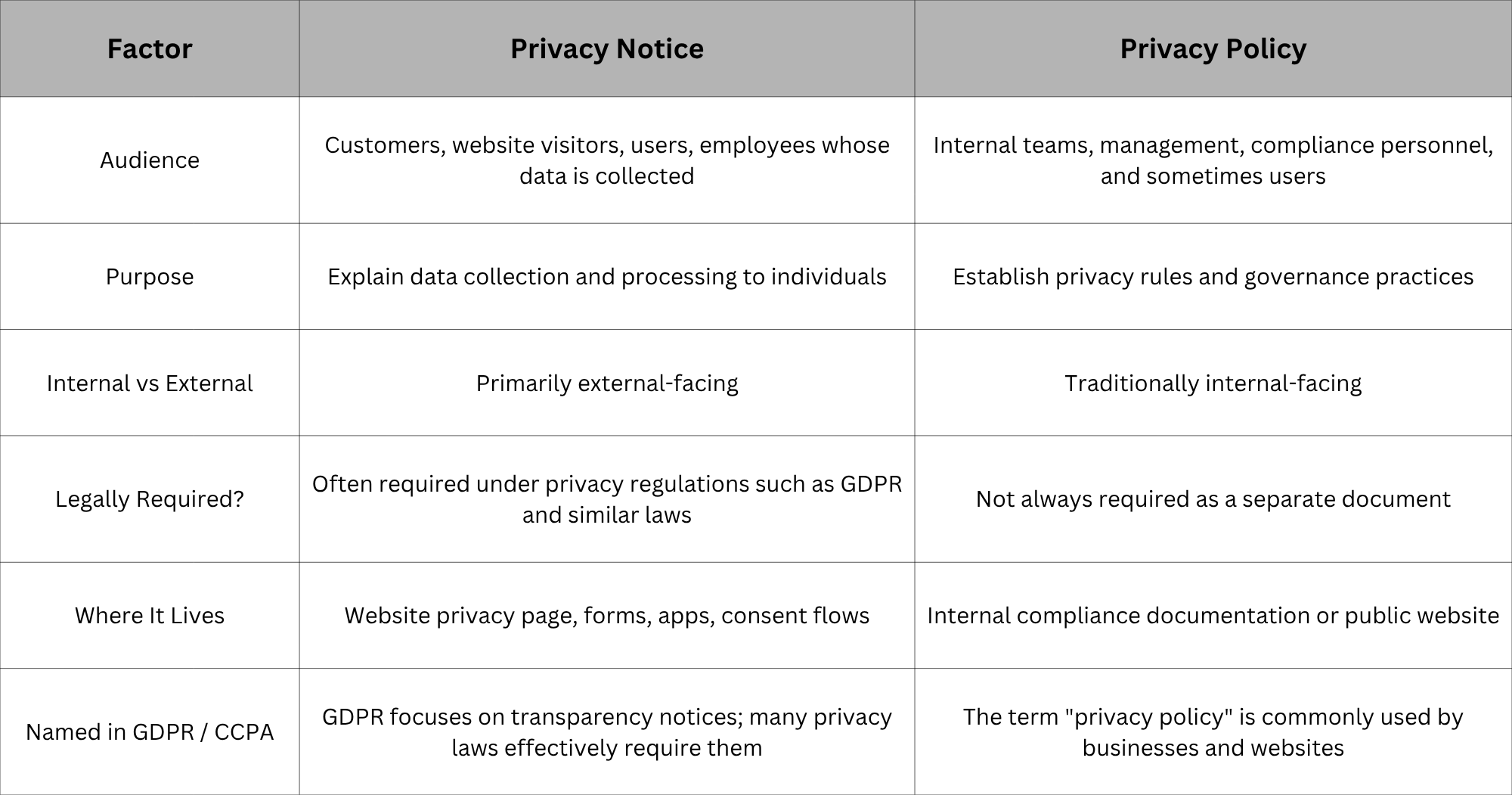
For most modern websites, the public-facing privacy page acts as both a privacy notice and a privacy policy, combining transparency requirements with organizational privacy commitments.
Why the Terms Get Used Interchangeably
The confusion between privacy notices and privacy policies largely stems from differences in legal terminology, industry practice, and the evolution of privacy compliance over time.
Historically, organizations maintained internal privacy policies that guided employee behavior and data management practices. These policies were often separate from the information provided to customers and website visitors.
As internet usage expanded and privacy regulations became more common, organizations began publishing public privacy documents on their websites. These documents frequently adopted the familiar title "Privacy Policy" even though their primary purpose was to notify users about data processing activities.
The GDPR accelerated this overlap. European privacy law focuses heavily on transparency and informing individuals about how their personal data is used. While privacy professionals often refer to these disclosures as privacy notices, many organizations continued using the more familiar "Privacy Policy" label because users already recognized it.
The CCPA and similar U.S. state privacy laws further contributed to the blending of terminology. These laws generally require businesses to provide privacy disclosures but do not always insist on specific document names.
As a result, modern websites often use:
- Privacy Policy
- Privacy Notice
- Privacy Statement
- Privacy Disclosure
to describe substantially similar documents.
The title may differ, but the legal objective remains the same: informing people about how their personal information is handled.
Which One Does Your Website Actually Need?
For most websites, the answer is straightforward: you need a public-facing privacy document that satisfies applicable privacy laws, regardless of whether you call it a privacy notice or privacy policy.
If You Run a Simple Informational Website
Even a basic website may collect personal information through:
- Contact forms
- Newsletter signups
- Analytics tools
- Cookies
- Server logs
In these situations, a privacy disclosure is generally recommended and may be legally required depending on your audience and location.
If You Collect Personal Data
Any website that collects identifiable information should provide a detailed privacy document explaining:
- What data is collected
- Why it is collected
- How it is used
- Whether it is shared
- How users can exercise their rights
This applies to blogs, SaaS products, ecommerce stores, membership websites, online communities, and mobile applications.
If You Have GDPR Exposure
If your website serves users in the European Economic Area, GDPR transparency requirements likely apply. You must provide users with information about:
- Data controllers
- Processing purposes
- Legal bases
- Retention periods
- Individual rights
In practice, this means providing a comprehensive privacy notice.
If You Have CCPA or U.S. State Privacy Law Exposure
Businesses covered by California and other state privacy laws must provide privacy disclosures describing:
- Categories of personal information collected
- Purposes of collection
- Sharing practices
- Consumer rights
A public privacy policy is typically used to meet these obligations.
Best Practice
Most organizations maintain:
- An internal privacy policy governing company practices.
- A public privacy notice (usually titled Privacy Policy) informing users.
This approach provides both operational governance and legal transparency.
What Each Document Should Include
Although there is considerable overlap, each document serves a slightly different purpose.
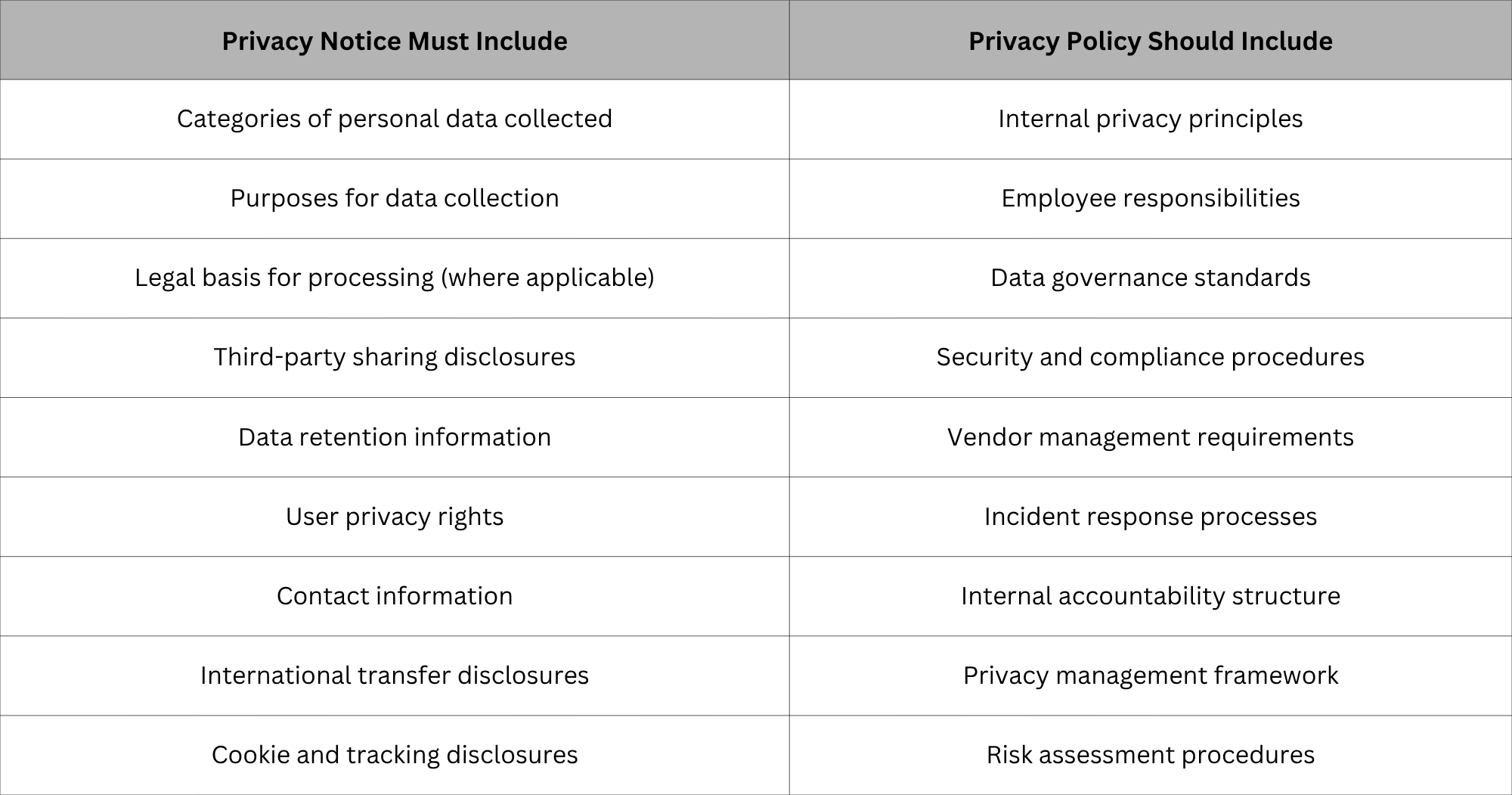
For most websites, the publicly available document should prioritize transparency and user understanding while still accurately reflecting organizational privacy practices.
Privacy Notice, Cookie Policy & Consent: How They Fit Together
Privacy compliance involves multiple documents working together rather than a single standalone policy.
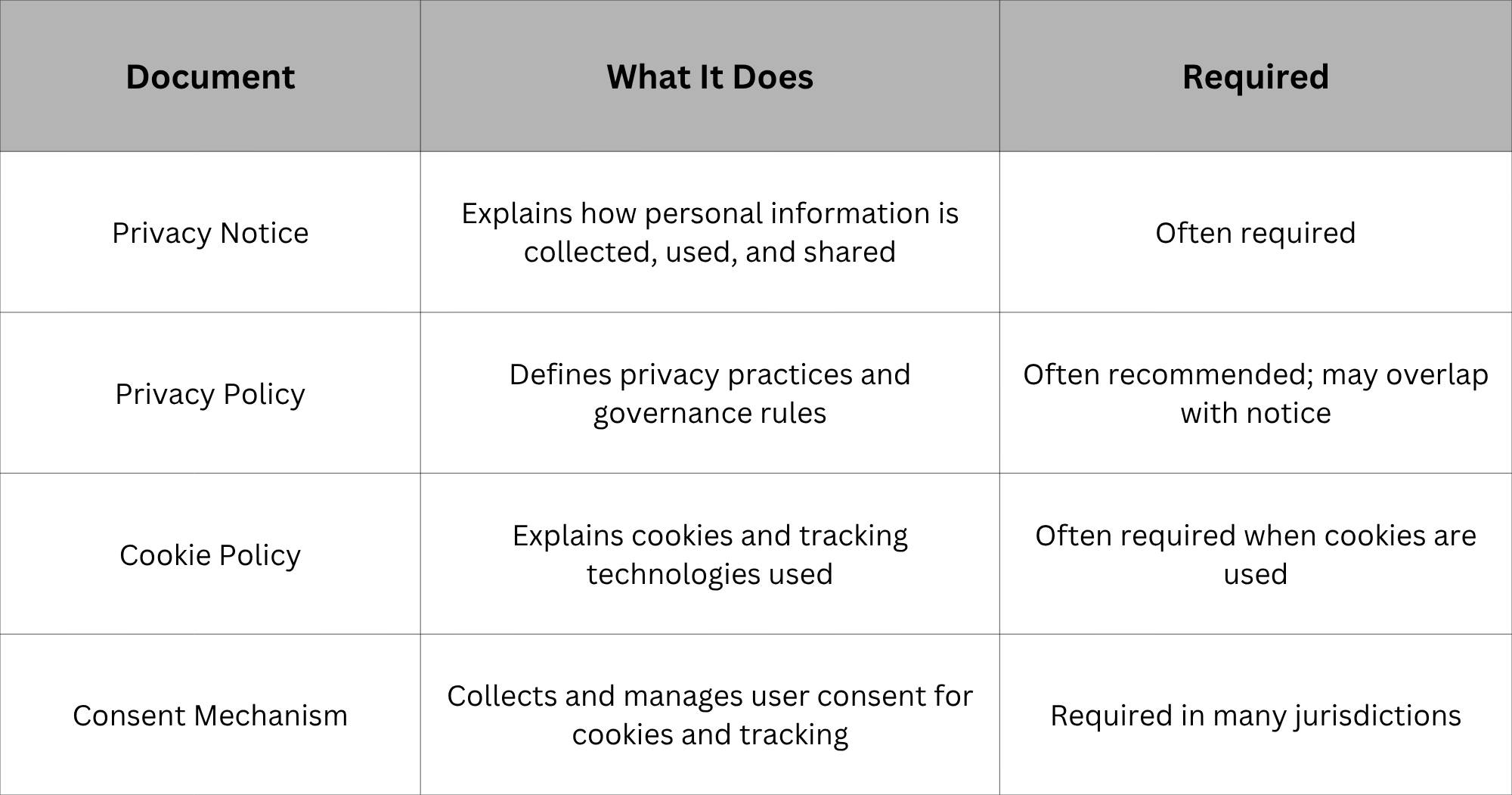
A privacy notice tells users what information is collected and why. A cookie policy explains the specific tracking technologies used on the website. A consent platform records and manages user permission before non-essential cookies are activated.
Together, these elements form the foundation of modern privacy compliance.
Important: A privacy notice tells users what data you collect, but it does not replace cookie consent requirements. If your website uses analytics, advertising, or tracking technologies, you may still need an active consent solution such as ConsentBit before those cookies are deployed.
Frequently Asked Questions
1 . Is a privacy notice the same as a privacy policy?
Not exactly. A privacy notice is specifically designed to inform individuals about how their personal data is collected and used. A privacy policy traditionally refers to broader organizational privacy rules. In practice, most websites combine both functions into a single public document and often call it a Privacy Policy.
2. Does GDPR require a privacy notice or a privacy policy?
GDPR focuses on transparency obligations and effectively requires organizations to provide individuals with information about data processing activities. This requirement is commonly satisfied through a privacy notice. Many organizations publish that notice under the title "Privacy Policy," which is generally acceptable if all required disclosures are included.
3. Do I legally need both a privacy policy and a privacy notice?
Usually not as separate public documents. Most websites publish one privacy page that functions as both a privacy notice and a privacy policy. Larger organizations may also maintain internal privacy policies for governance and compliance purposes in addition to their public privacy notice.
4. What's the difference between a privacy notice and a privacy statement?
The difference is usually minimal. Privacy statement is another term commonly used to describe a public privacy disclosure. Depending on the organization, a privacy statement, privacy notice, and privacy policy may contain nearly identical information and serve the same transparency purpose.
5. Where should I place my privacy notice on my website?
A privacy notice should be easy to find and accessible from every page. Most websites place a link in the footer and also display it near forms, account registration pages, checkout flows, and consent banners. Easy access supports transparency and helps satisfy privacy law requirements.