




Subscribe to ConsentBit Newsletter
Data Privacy
10 Disclaimer Examples (Copy-Paste Templates for Your Website)

31
July
2026
TL;DR
- A disclaimer is a statement that limits legal liability by clarifying responsibilities, risks, limitations, or the intended use of information, products, or services.
- Different types of disclaimers protect against different risks, including medical advice claims, financial losses, copyright disputes, affiliate relationships, and content accuracy issues.
- Common disclaimer examples include medical disclaimers, affiliate disclaimers, copyright disclaimers, financial disclaimers, warranty disclaimers, and views expressed disclaimers.
- A disclaimer cannot eliminate all legal responsibility, but it can help reduce misunderstandings, set user expectations, and strengthen your legal position if disputes arise.
- The most effective disclaimers are clear, visible, specific to your business, and placed where users are likely to see them before relying on your content or services.
- Many websites need more than a disclaimer alone. Depending on your activities, you may also need a privacy policy, terms and conditions, cookie disclosures, and consent management.
- If your website publishes advice, recommendations, reviews, opinions, or affiliate content, a well-written disclaimer is considered a best practice and may be legally required in certain situations.
Whether you're running a blog, online store, SaaS platform, YouTube channel, newsletter, or professional website, you've probably seen disclaimer statements such as "for informational purposes only," "past performance does not guarantee future results," or "we may earn a commission from qualifying purchases." These short notices may seem simple, but they play an important role in managing legal risk and setting clear expectations for users.
A disclaimer helps explain the limits of your responsibility and clarifies how visitors should interpret your content, products, services, or recommendations. In many cases, disclaimers can help reduce liability by informing users about potential risks, conflicts of interest, or important limitations before they rely on the information you provide.
However, not all disclaimers serve the same purpose. A medical website requires different protections than an affiliate blog. A financial advisor faces different risks than a software company or ecommerce store. Using the wrong disclaimer or failing to use one at all can leave your business exposed to unnecessary legal and compliance risks.
Here you'll find 09 disclaimer examples that you can copy, customize, and adapt for your own website. Let’s dive in.
What Is a Disclaimer?
A disclaimer is a statement that limits legal liability by informing users about risks, restrictions, responsibilities, or limitations associated with content, products, services, or information.
Disclaimers are commonly used by businesses, website owners, content creators, publishers, healthcare providers, financial professionals, software companies, and ecommerce brands to clarify what users can and cannot reasonably expect.
For example, a medical website may explain that its articles are intended for educational purposes and should not be considered professional medical advice. A financial blog may state that investment information is not personalized financial guidance. An affiliate website may disclose that it earns commissions from certain links.
The primary purpose of a disclaimer is to improve transparency and reduce misunderstandings. By clearly communicating limitations, businesses can help users make informed decisions and reduce the likelihood of legal disputes arising from unrealistic expectations.
It is important to understand that a disclaimer does not provide absolute legal protection. Courts generally consider many factors when evaluating liability. However, a properly written and prominently displayed disclaimer can strengthen your legal position and demonstrate that users were informed about important risks or limitations before engaging with your content or services.
For most websites, disclaimers work best when combined with other legal documents such as privacy policies, terms and conditions, and cookie disclosures.
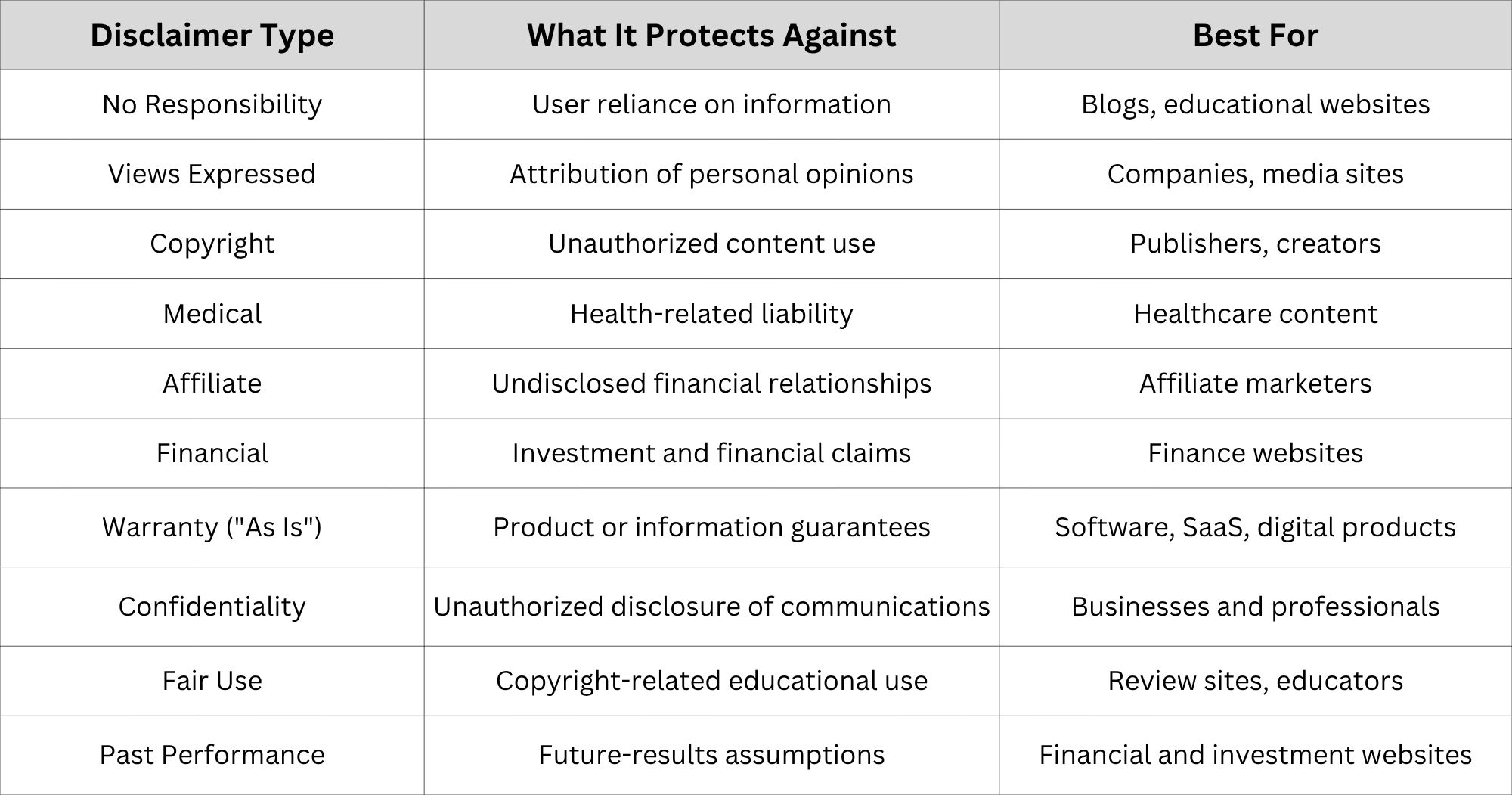
Quick Comparison: Types of Disclaimers at a Glance
Disclaimer Examples You Can Copy
1 . No Responsibility Disclaimer
Best for: Blogs, educational websites, informational content
This disclaimer explains that users are responsible for how they use information provided on the website.
The information provided on this website is for general informational purposes only. While we strive to keep the information accurate and up to date, we make no guarantees regarding its completeness, accuracy, reliability, or suitability. Any reliance you place on such information is strictly at your own risk.
2. Views Expressed Disclaimer
Best for: Corporate blogs, employee content, guest contributors
This disclaimer separates individual opinions from official organizational positions.
The views and opinions expressed on this website are those of the authors and do not necessarily reflect the official policy, position, or views of the company, its management, employees, or affiliates.
Real-world example: News organizations, universities, and corporate blogs commonly use this disclaimer for opinion articles and guest contributions.
3. Copyright Disclaimer
Best for: Content creators, publishers, bloggers
This disclaimer helps establish ownership of original content.
Unless otherwise stated, all content published on this website, including text, graphics, logos, images, and digital materials, is the property of the website owner and is protected by applicable copyright laws. Unauthorized use, reproduction, or distribution is prohibited without prior written permission.
4. Medical Disclaimer
Best for: Health blogs, wellness websites, healthcare businesses
Medical content can be particularly sensitive because users may make decisions affecting their health.
The content on this website is provided for educational and informational purposes only and is not intended as medical advice. Always seek the advice of a qualified healthcare professional regarding any medical condition, diagnosis, or treatment. Never disregard professional medical advice because of information found on this website.
Real-world example: Major health publishers often place medical disclaimers near articles discussing symptoms, medications, and treatment options.
5. Affiliate Disclaimer
Best for: Affiliate websites, product review blogs, influencers
Many jurisdictions require disclosure of material relationships.
Some links on this website may be affiliate links. This means we may earn a commission if you click a link and make a purchase, at no additional cost to you. We only recommend products and services we believe may provide value to our audience.
6. Financial Disclaimer
Best for: Investment blogs, financial educators, advisors
Financial information can significantly influence decision-making.
The information provided on this website is for educational purposes only and should not be considered financial, investment, tax, or legal advice. You should consult a qualified professional before making any financial decisions. Investing involves risk, including the possible loss of principal.
7. Warranty ("As Is") Disclaimer
Best for: Software companies, SaaS providers, digital products
This disclaimer limits expectations regarding performance and reliability.
This website and all related services are provided on an "as is" and "as available" basis without warranties of any kind, either express or implied. We make no guarantees regarding availability, reliability, performance, or fitness for a particular purpose.
8. Confidentiality Disclaimer
Best for: Professional services, consultants, email communications
This disclaimer is commonly included in emails and sensitive communications.
This communication may contain confidential or privileged information intended solely for the recipient. If you are not the intended recipient, any review, distribution, or use of this information is prohibited. Please notify the sender and delete the communication immediately.
9. Fair Use Disclaimer
Best for: Educational content, commentary, criticism, reviews
This disclaimer explains limited use of copyrighted material.
This website may contain copyrighted material used for purposes such as criticism, commentary, news reporting, teaching, scholarship, or research. Such use is believed to constitute fair use under applicable copyright laws.
10. Past Performance Disclaimer
Best for: Investment firms, trading websites, financial publishers
Historical results should not be presented as guarantees.
Past performance is not indicative of future results. Any historical returns, expected returns, or probability projections may not reflect actual future performance. Investments involve risk and may lose value.
How to Write a Disclaimer That Actually Holds Up
A disclaimer is only effective if it is clear, relevant, and visible. Simply copying generic language from another website may not provide meaningful protection if the disclaimer does not accurately reflect your business activities.
When writing a disclaimer:
1 . Be Specific
Avoid vague statements. Identify the exact risks, limitations, or relationships you are disclosing.
2. Use Plain Language
Legal jargon can confuse users. Courts and regulators generally favor transparency and clarity over overly complex language.
3. Match Your Business Model
A medical website needs different disclosures than a software company or affiliate marketer. Customize the disclaimer to your specific activities.
4. Place It Where Users Will See It
A disclaimer hidden on an obscure page may be less effective than one placed near relevant content or actions.
5. Keep It Updated
As your products, services, content, or revenue models change, your disclaimer should evolve as well.
Most importantly, remember that a disclaimer supplements your legal protections—it does not replace professional legal advice, terms and conditions, or regulatory compliance requirements.
Where to Place Your Disclaimer + Real-World Examples
The placement of a disclaimer can be just as important as its wording.
Common locations include:
- Website footer
- Terms and Conditions page
- Dedicated Disclaimer page
- Product review pages
- Affiliate content pages
- Medical or financial articles
- Checkout pages
- Email footers
- Contact forms
For example, affiliate disclosures should appear near affiliate links rather than being buried in a separate legal page. Medical disclaimers should be visible on health-related content where readers may rely on the information. Financial disclaimers should accompany investment-related recommendations and performance claims.
The closer a disclaimer appears to the activity or content it addresses, the more effective it is likely to be.
As a general best practice, maintain a dedicated disclaimer page while also displaying context-specific disclaimers where relevant.
Why Your Website Needs a Disclaimer
Disclaimers help reduce misunderstandings and establish reasonable expectations between website owners and users.
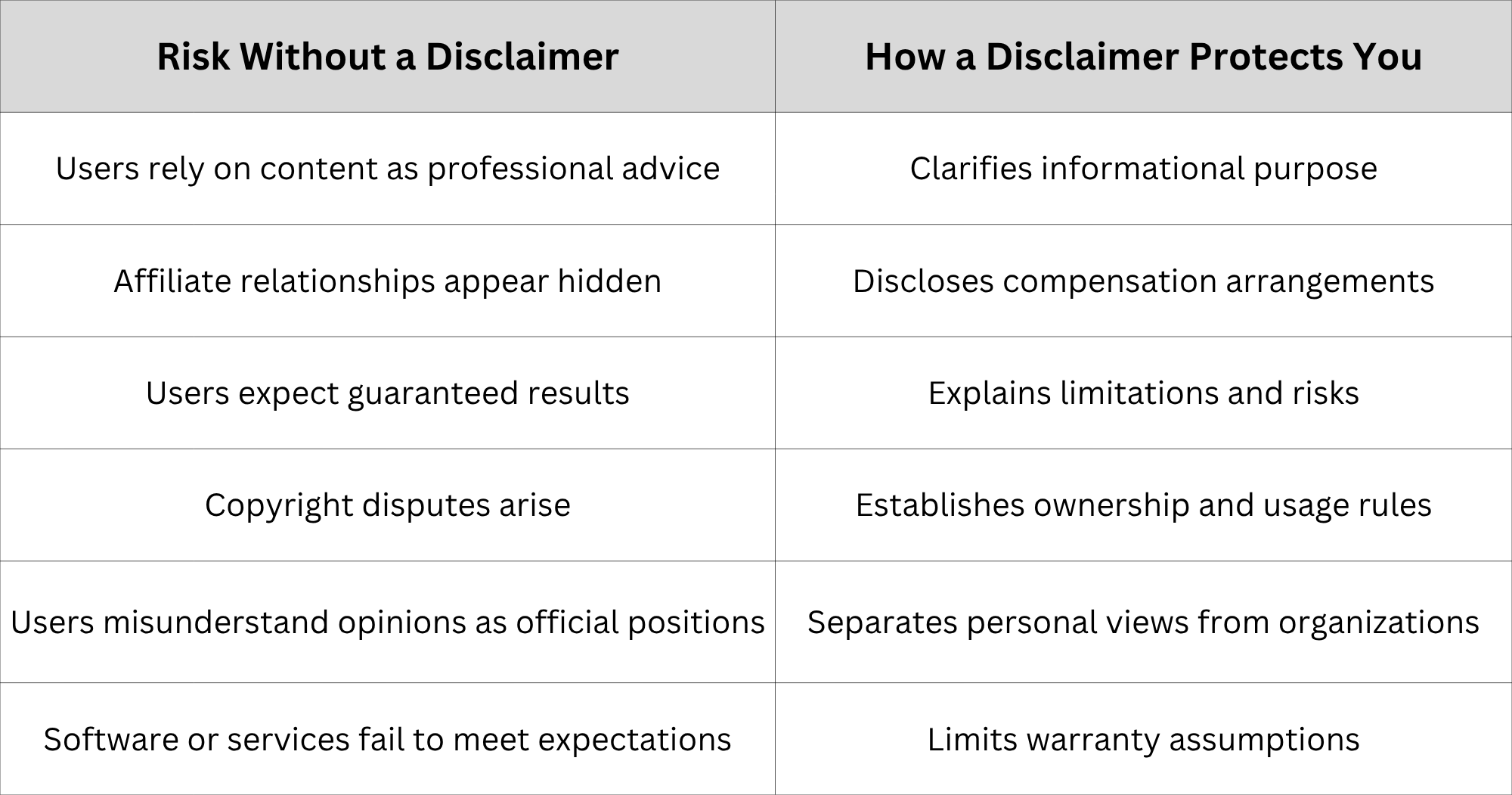
While disclaimers cannot eliminate all liability, they create transparency and help demonstrate that users were informed about relevant limitations before acting.
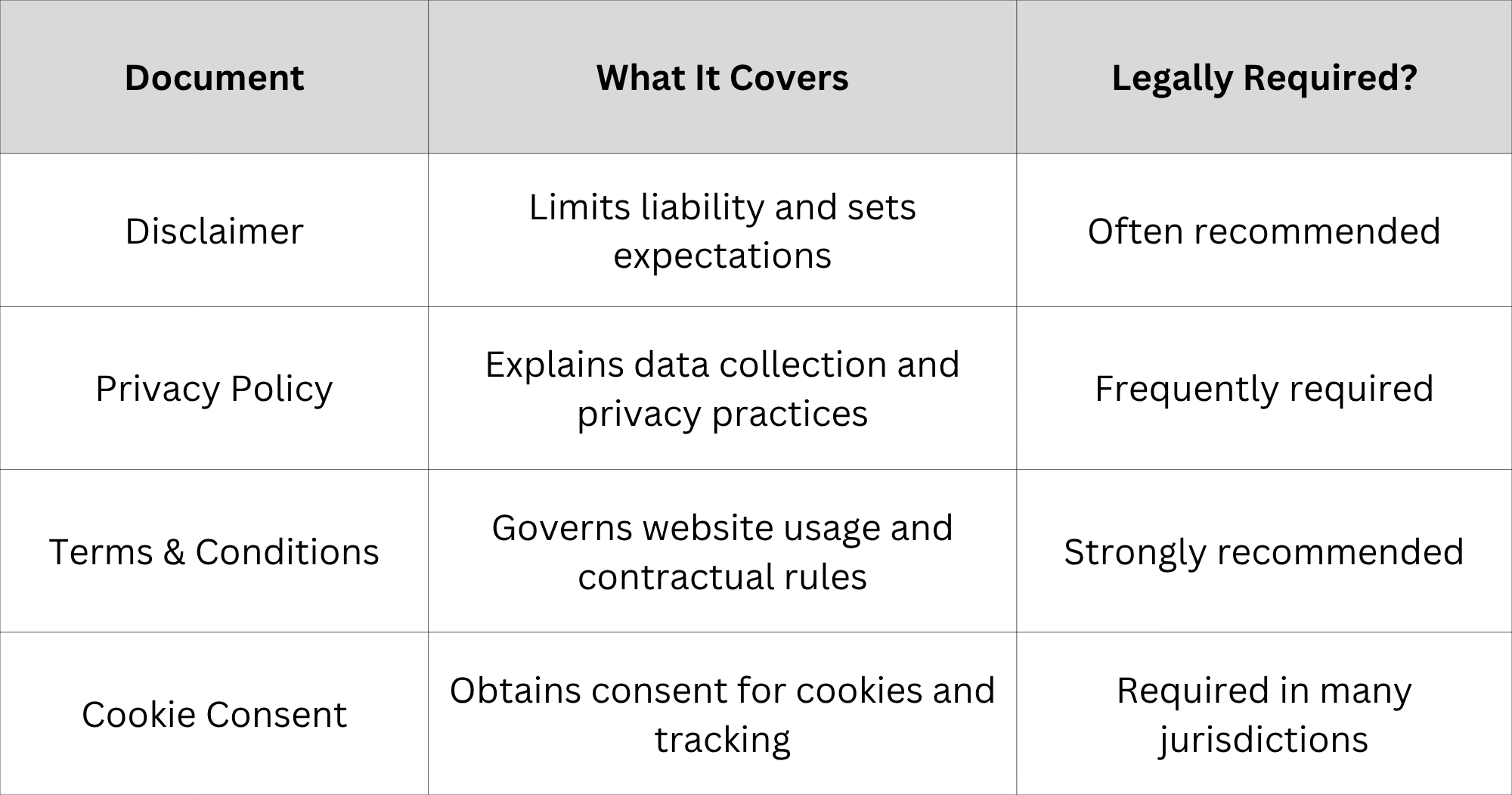
Disclaimer vs. Privacy Policy vs. Terms vs. Cookie Consent
Each document serves a different purpose within your website's compliance framework.
Disclaimers help reduce misunderstandings and establish reasonable expectations between website owners and users.
A disclaimer helps reduce liability related to content, products, or services. A privacy policy explains how personal data is handled. Terms and conditions establish rules governing website use. Cookie consent mechanisms manage permissions for tracking technologies.
Together, these documents form the foundation of a well-governed website.
Important: A disclaimer may help limit liability for your content, but if your website uses analytics, advertising, or tracking technologies, you may also need compliant cookie consent management. A disclaimer alone does not satisfy privacy law requirements.
Frequently Asked Questions
1. What is a simple disclaimer example?
A simple disclaimer example is: "The information on this website is provided for general informational purposes only and should not be considered professional advice." This type of disclaimer helps clarify that users should not rely exclusively on the content when making important decisions.
2. How do I write a disclaimer for my website?
Start by identifying the specific risks associated with your website, products, services, or content. Then write a clear statement explaining limitations, responsibilities, or disclosures relevant to those risks. The disclaimer should be easy to understand, visible to users, and tailored to your business activities.
3. Do I legally need a disclaimer on my website?
Not every website is legally required to have a disclaimer. However, websites providing advice, reviews, affiliate recommendations, medical information, financial content, or professional services often benefit from disclaimers and may be subject to disclosure requirements depending on applicable laws.
4. What's the difference between a disclaimer and a privacy policy?
A disclaimer limits liability and explains risks or limitations related to content and services. A privacy policy explains how personal information is collected, used, stored, and shared. They serve different legal purposes and are often used together on the same website.
5. Is a website disclaimer legally binding?
A disclaimer can strengthen your legal position and help demonstrate transparency, but it is not automatically enforceable in every situation. Its effectiveness depends on factors such as wording, visibility, applicable laws, and the specific circumstances of any dispute.