




Subscribe to ConsentBit Newsletter
Data Privacy
Data Privacy Compliance: The Complete Guide for 2026

20
May
2026
01
June
2026
TL;DR
1. Data privacy compliance means following laws that explain how businesses should collect, use, store, and protect personal data responsibly.
2. Modern privacy laws such as GDPR, CCPA, LGPD, and the DPDP Act give users more control over their personal information and require businesses to be transparent.
3. Almost every website today collects some form of personal data through cookies, analytics tools, forms, advertising systems, or customer accounts, which means compliance affects businesses of all sizes.
4. Strong privacy compliance involves clear consent management, updated privacy policies, secure data handling, proper documentation, and support for user privacy rights.
5. Platforms like ConsentBit help businesses simplify global privacy compliance by managing cookie consent, user preferences, and compliance workflows through one centralized system.
Why Data Privacy Compliance is Important in 2026
The internet as we know it today relies extensively on collecting information about its users.
Every time a person engages with some aspect of the internet, whether that is through browsing the web, creating an account, buying a product, signing up for a newsletter, videos or advertising, data gets collected behind the scenes. Many websites utilize cookies and tracking technologies to gain insight into how users interact with them, enhance service delivery, estimate site traffic volumes and personalize ad delivery campaigns.
With advancements in digital systems, privacy regulation agencies across the world began implementing stricter privacy laws designed to protect consumers and their personal data. Over the last several years, compliance has transitioned from an obligation to adhere to laws into an increasingly important aspect of doing business.
The biggest reason for why privacy legislation is important today is that regulations now apply on a global scale. Therefore regardless of whether or not a company has a physical presence within Europe, GDPR may apply if European Users access that business’ website; similarly European Users accessing businesses operating within The US will have access protection under CCPA ; Brazilian Users accessing businesses operating within the US will have access protection under LGPD; and Indian users accessing businesses operating within the US will have access protection under the DPDP Act.
As such, businesses cannot longer utilize just a local approach to managing user data. It is very possible for multiple users from numerous countries, accessing your website simultaneously to each be subjected to varying legal obligations.
At the same time, privacy enforcement has become more rigorous. Regulators have been giving larger penalties for violations, browsers have been reducing support of invasive tracking practices, and even users have become more conscious of how they use their information.
Trust has been the major issue for those doing business online. Many users now have a preference for companies that are forthcoming about their privacy practices and provide clear consent options. Businesses that fail to act responsibly in their handling of data will lose the trust of their customers in a very short time.
Furthermore, privacy compliance affects all forms of marketing, analytics, advertising, and customer relationship systems. Many advertising platforms and analytics tools now require user consent before they can collect behavioral data.
Because of all of these changes, privacy compliance is no longer an option. Privacy compliance is now a critical aspect of doing business on the internet as a professional and reputable digital business in 2026.
What is Data Privacy Compliance?
Data privacy compliance refers to following legal and regulatory requirements that control how organizations collect, process, store, share, and protect personal information.
Personal data includes any information that can identify a person directly or indirectly. Many people think personal data only includes names or phone numbers, but modern privacy laws define personal information much more broadly.
Examples of personal data include:
- Full names
- Email addresses
- Phone numbers
- Home addresses
- Payment information
- Government identification numbers
- IP addresses
- Device identifiers
- Cookie IDs
- GPS location data
- Browsing history
- Online behavior patterns
Privacy compliance is not a single task or software tool. It is a complete system involving legal policies, technical protections, operational processes, and organizational accountability.
At the legal level, businesses must create privacy policies, cookie notices, consent forms, and vendor agreements that explain how user data is handled. These documents should clearly describe what information is collected and why it is needed.
At the technical level, organizations must protect data using secure systems. This often includes encryption, access control systems, secure cloud storage, firewalls, authentication systems, and monitoring tools that reduce the risk of data breaches.
At the operational level, businesses need procedures for handling user requests. Many privacy laws give users the right to request access to their information, correct inaccurate data, download copies of their records, or request deletion of personal information.
At the organizational level, privacy compliance requires internal accountability. Companies may need employee training programs, privacy audits, data management policies, and clear responsibilities for teams handling user data.
An important point to understand is that privacy compliance is not something businesses complete once and forget about. It is an ongoing process because laws, technologies, and business operations continue changing over time.
Privacy vs Security: Understanding the Difference
Privacy and security are closely related concepts, but they are not the same thing. Many organizations incorrectly assume that strong cybersecurity automatically means they are privacy compliant. In reality, privacy and security solve different problems.
Data privacy focuses on how personal information is collected and used. It asks questions such as:
- Should this data be collected?
- Did the user agree to it?
- Is the business being transparent?
- Is the data being used fairly?
- Are users able to control their information?
Privacy is mainly about user rights and responsible data handling.
Data security, on the other hand, focuses on protecting information from unauthorized access, theft, breaches, or cyberattacks. Security systems help prevent hackers, malware, ransomware, or internal misuse from exposing sensitive information.
Security usually involves technical protections such as:
- Encryption
- Password systems
- Multi-factor authentication
- Firewalls
- Monitoring systems
- Access restrictions
- Secure backups
A company may have excellent security systems but still violate privacy laws if it collects data without proper consent. Similarly, a company may have transparent privacy notices but still fail compliance if the stored data is not properly protected.
Modern privacy regulations expect businesses to maintain both privacy and security together.
Major Privacy Regulations You Need to Know
The presence of privacy laws can be observed all around the world and the emergence of new laws is seen each year. Despite the differences between such privacy laws, their main idea is aimed at ensuring more freedom of users in terms of controlling their personal data.
Knowledge of key privacy laws is vital as numerous companies do have an international character even if the company operates only through its website.
GDPR (European Union)
General Data Protection Regulation (GDPR) is one of the most stringent pieces of legislation when it comes to privacy. This act entered into force in 2018 and revolutionized how businesses treat data privacy on a global level.
GDPR is applicable to organizations that either collect or process data related to EU or EEA residents.
First of all, one of the key requirements of GDPR is very stringent consent requirement. For instance, organizations should have user consent before collecting any personal information for marketing, tracking, or analysis purposes.
Secondly, under GDPR users have multiple rights, such as:
- The right of access to their data
- The right to rectification of any false information
- The right to erasure or data deletion
- The right to data portability
- The right to objection
In addition, GDPR is a regulation that includes the principle of accountability. In other words, organizations must keep records of how personal data is processed and protected.
Finally, GDPR has some severe penalties, which make businesses outside Europe adhere to GDPR standards.
CCPA and CPRA (California, USA)
The California Consumer Privacy Act (CCPA) and the California Privacy Rights Act (CPRA) are two of the largest privacy legislations in America.
Whereas GDPR is centered on obtaining opt-in consent from users, the CCPA largely operates under the opt-out model where users can demand information on what data a company collects and prevent the company from selling that information.
California's rules have had a large impact on digital advertising as most online advertising systems rely on the exchange and sharing of data.
LGPD (Brazil)
Brazilian Lei Geral de Proteção de Dados, which means LGPD, has been designed following GDPR guidelines.
LGPD emphasizes the need for clarity and lawful processing of data along with the consent of users. LGPD regulates companies processing personal data of citizens of Brazil.
LGPD also calls for proper security systems for data and accountability for data processing activities.
DPDP Act (India)
The Digital Personal Data Protection Act of India can be considered among the most recent data protection laws.
The key provisions of the DPDP Act revolve around data handling based on consent and cross-border transfer of data. In addition, the Act contains some obligations in connection with data processing of personal information.
Due to constant growth in India's digital sphere, this Act gains increasing significance.
PIPEDA (Canada)
PIPEDA, Canada’s personal information privacy legislation, mandates that organizations acquire valid consent before they collect personal information from consumers.
Businesses need to state the reasons for data collection and how it will be utilized. Users should comprehend the manner in which their information will be used.
US State Privacy Laws
Currently, there is no privacy law in place within the country. On the other hand, there have been efforts made by a number of states to come up with their own respective privacy laws.
It makes it harder to comply with all the regulations since companies will now have to deal with varying requirements based on the location of the users.
Virginia, Colorado, Connecticut, Utah, and Texas are some of the states that have passed privacy laws in the last few years.
Privacy Regulations Compared: GDPR vs CCPA vs LGPD vs DPDP
Although privacy laws differ by country, most modern regulations are moving toward the same overall direction: greater transparency, stronger consent systems, and more user control over personal data.
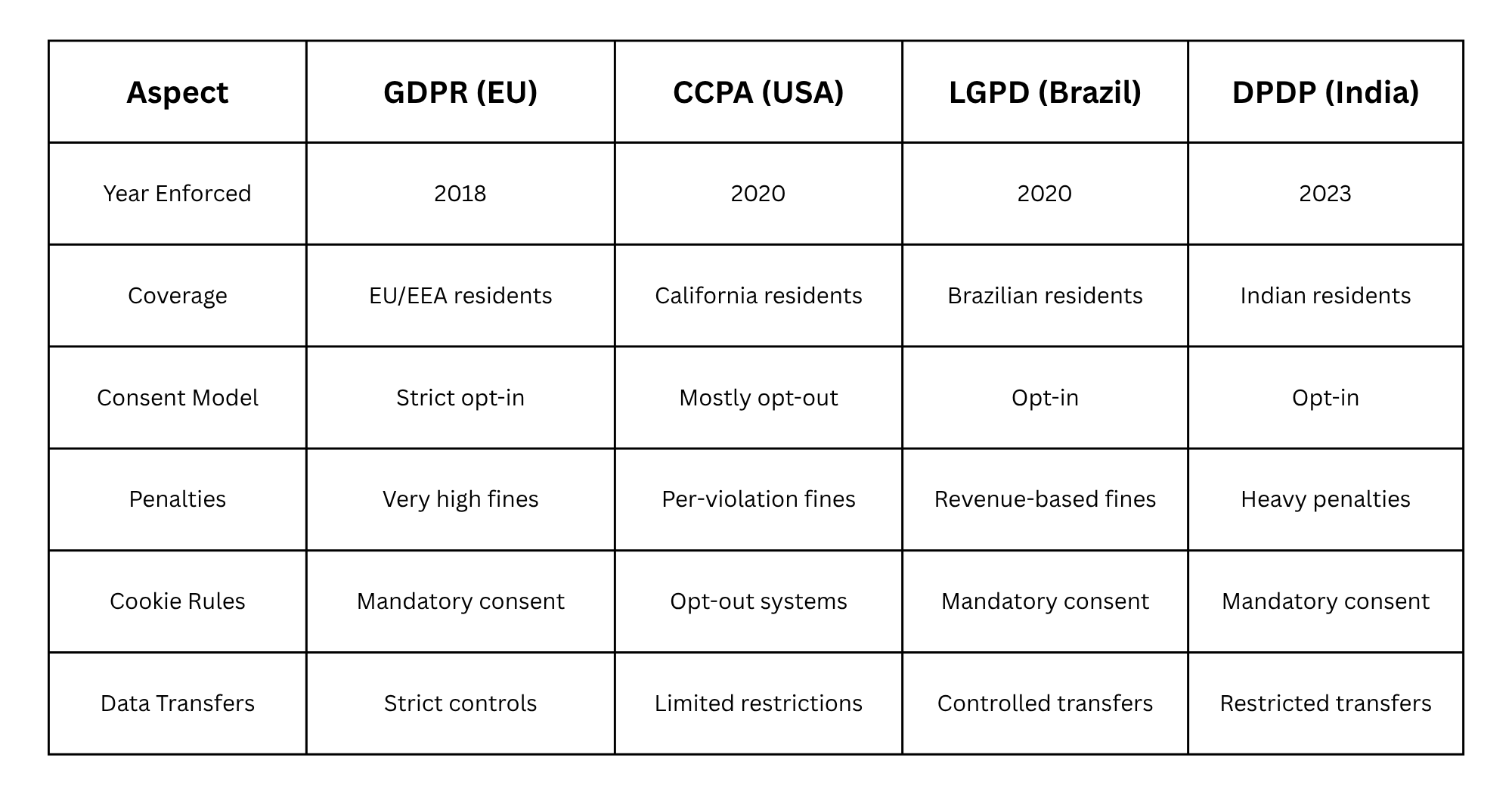
For most modern businesses, the challenge is not complying with one regulation. The challenge is handling several privacy laws at the same time through one consistent system.
The 7 Core Principles of Data Privacy Compliance
Although privacy laws vary across countries, most regulations are built around a common set of principles. These principles define what responsible and lawful data handling looks like.
Understanding these principles helps businesses build stronger compliance systems regardless of which laws apply to them.
1. Transparency
Organizations must clearly explain what data they collect, why they collect it, how it will be used, and who may receive access to it. Users should not need advanced legal knowledge to understand privacy notices. Information should be written in clear and understandable language.
2. Purpose Limitation
Businesses should only use personal data for the specific purpose originally explained to users. If a company collects information for account creation, it should not later use the same information for unrelated advertising purposes without proper consent.
3. Data Minimization
Organizations should collect only the information that is actually necessary. Collecting excessive data increases compliance risks, storage costs, and security exposure.
4. Accuracy
Personal information should remain accurate and updated whenever possible. Incorrect or outdated information may create operational problems and reduce trust.
5. Storage Limitation
Data should not be stored forever. Businesses should define retention periods and remove information when it is no longer needed.
6. Security
Organizations must protect personal information using strong technical and organizational safeguards. This may include encryption, access controls, authentication systems, monitoring tools, and secure infrastructure.
7. Accountability
Businesses should be able to prove that they follow privacy regulations correctly. This often includes maintaining consent records, security documentation, internal policies, audit logs, and vendor agreements. These principles form the foundation of most modern privacy laws worldwide.
Data Privacy Compliance Checklist (10 Steps)
A successful privacy compliance strategy is the implementation of a systematic privacy framework that evolves step by step. Apart from legal compliance, organizations should also strive for improved transparency, accountability, data protection, and consumer trust. The following 10-step plan describes how companies can achieve privacy compliance in 2026.
1. Map All Personal Data
The initial stage towards compliance regarding privacy issues is the identification of the type and amount of personal data that the company deals with. It should be understood that the business usually possesses much more personal data than it thinks, as it can originate from various sources, including but not limited to contact forms, newsletters, analytics systems, payment processing services, customer databases, cookies, and advertisements.
The organization should carefully consider the origin of the personal data, its storage location, retention period, users having access to the data, and possible sharing with third parties. This process is referred to as data mapping. Data mapping enables the company to gain necessary knowledge for compliance management and addressing the users' demands properly.
Additionally, data mapping assists in identifying unnecessary collection of personal data. Usually, organizations retain their data collection practices even when they are no longer required.
2. Identify Which Privacy Laws Apply
The rules regarding privacy will depend on the particular country, region, or types of users for which the business caters. One of the difficulties associated with modern privacy compliance involves having multiple laws apply to your business.
For instance, you may be required to comply with GDPR if your website has any European users, and CCPA if your users happen to reside in California. Companies working in India will need to consider the DPDP Act while Brazilian users will have to be considered in light of LGPD.
With modern businesses becoming inherently global entities, complying with privacy regulations cannot just mean complying with the particular country’s regulations. A company needs to think about its global user base and figure out which laws apply to them.
This information is crucial since different regulations may imply different requirements when it comes to consent, data transfer, retention period, user rights, etc.
3. Update the Privacy Policy
The privacy policy is one of the essential components of any compliance program since it outlines how an entity processes personal data. Too many companies tend to consider their privacy policies as purely legal documents full of terminology which may not be easily comprehensible to users.
However, contemporary privacy regulations tend to push entities towards transparency, requiring them to clearly explain how they process users' personal information by outlining what kind of data is being gathered, why, for what purposes, who will have access to the data, and for how long the data will be retained.
Another important point that needs to be covered in a good privacy policy concerns users' rights in relation to their personal information and ways they may reach out to the company with any privacy-related questions.
Regular review of privacy policies is essential due to frequent changes in organizational procedures and third-party service providers.
4. Implement Proper Consent Management
Consent management has increasingly emerged as an integral part of compliance with modern privacy legislation, particularly for websites implementing cookies, analytical platforms, advertisement software, or behavioral targeting tools.
Under some privacy laws, companies need to seek clear and explicit consent of users to collect particular types of personal data. It must be provided voluntarily, specific, unambiguous, and easily revocable.
Users cannot be coerced into agreeing to any tracking technology, and companies must refrain from manipulative consent banners or automatically selected checkboxes reducing user freedom of choice.
Manual consent management becomes increasingly complicated when websites become more intricate and cross-border in their operations. That is why some businesses utilize consent management platforms like ConsentBit in order to manage consent notices, user choices, consent history, and regional requirements for privacy compliance from a single source.
Properly implemented consent management will also create documents which can prove useful for companies should regulators ask for evidence of compliance.
5. Enable User Privacy Rights
The most radical change brought about by modern-day privacy laws relates to expanding users’ rights. Users will now enjoy increased control over the handling of their personal information when online.
Depending on the relevant legislation, users can exercise the right to obtain access to their data, correct it, make backups of their personal information, revoke consent previously given, and get their data deleted.
To ensure efficient management of such requests, businesses must devise streamlined procedures. Otherwise, ignoring requests and delaying responses might lead to complaints, investigations, and even fines.
Today, companies are developing privacy dashboards and self-service options that empower users to control their personal data and preferences.
6. Review Third-Party Vendors and Services
Almost all contemporary companies depend significantly on the help of third-party vendors for performing their day-to-day activities. Such vendors can be cloud vendors, analytic vendors, financial services providers, advertising agencies, etc.
It becomes quite tricky when vendors process personal data of their clients. Even though other companies do the job, the originating company can still be held responsible for the processing of such data.
For that reason, it is crucial to perform due diligence before any personal information is shared by an organization with its vendor. This due diligence must clarify what procedures are used by the vendor for storing, analyzing, transferring data, etc.
Vendor agreements must contain specific statements regarding data security and compliance with legal requirements. Vendor risk management currently has become one of the most critical aspects of contemporary privacy compliance.
7. Strengthen Data Security Measures
Privacy compliance and cybersecurity are interlinked issues since private data can only be kept private when the organization implements adequate security measures.
Even when an organization is compliant with data collection standards, the lack of security measures may bring severe consequences upon it if any user data is compromised.
It is imperative for organizations to protect themselves from cyber attacks by putting into place various security measures such as account security, limiting the access of sensitive data, database security, monitoring activities, and ensuring there are secure backups.
Accessing personal information by employees must only be restricted to those who have a need for the data based on their job descriptions.
8. Train Employees on Privacy Responsibilities
Indeed, the human error is still the most frequently mentioned factor that causes privacy problems or violations. Such factors as inappropriate communication, insufficiently secure passwords, phishing, and other risky activities could lead employees to revealing some sensitive data.
This explains why privacy compliance cannot be confined only to the legal and IT departments. Any employee dealing with customer data should know about his/her responsibility to protect such information.
Companies need to educate their employees on what measures are taken and what steps are to be made in order to maintain compliance. People should know the basics of privacy, data security, consent, data protection, etc.
Good training would eliminate the risk of compliance failure or unintentional exposure of sensitive data.
9. Maintain Compliance Documentation
Current privacy laws place much focus on accountability. Companies can be required to show evidence that they comply with the laws as opposed to simply stating that they do.
It means that companies need to have sufficient documentation regarding issues such as obtaining consents, handling data, security, vendor contracts, training of employees, and privacy policies.
Such documentation becomes critical in cases when there is an audit or investigation carried out. If there are no records, then compliance will not be easily proven despite adhering to privacy laws internally.
In addition, keeping records enables businesses to evaluate their privacy compliance programs and make improvements where necessary.
10. Regularly Review and Improve Compliance
Privacy compliance does not represent an effort that an organization makes once and forgets. Legislation changes constantly, technological developments happen all the time, and organizations are always implementing new technologies and processes.
For this reason, businesses must conduct regular assessments and updates regarding their privacy practices. The privacy policy itself, the system of obtaining consent, privacy and data protection measures, vendor contracts, and other issues should be re-examined periodically to make sure everything is still in order.
Periodic reviews and assessments can assist organizations in recognizing any potential problems with privacy compliance before they grow into serious matters. Organizations that maintain privacy compliance on an ongoing basis are better positioned to deal with future challenges.
Conclusion
Data privacy compliance is essential for online businesses in 2026. With digital companies collecting user data via websites, applications, analytics, advertising, payment solutions, and account creation processes, regulations around the world have come to insist on strict data collection and usage policies.
Compliance affects trustworthiness, transparency, and the company's reputation. Lack of compliance may cause fines, legal problems, operational disruptions, and harm to reputation. Good data privacy practices help increase trust and loyalty among customers.
The problem is the complexity of the situation. Companies need to deal with multiple regulatory frameworks including GDPR, CCPA, DPDP, LGPD, as well as issues of cookies, consents, analytics, and third parties in their operations.
That is why many companies utilize centralized consent management services like ConsentBit. This tool consolidates data privacy into one solution for managing cookie consents and other related matters effectively without having to resort to different tools and extra costs.
For companies using analytics, advertising, and marketing technologies, structured consent management is becoming essential as privacy laws continue to evolve globally.
Privacy compliance is a core part of building secure, transparent, and trustworthy digital operations.
Get started with ConsentBit to simplify global privacy compliance and manage consent the right way.
Frequently Asked Questions
1. What is data privacy compliance?
Personal data privacy compliance is the observance of laws or regulations that oversee how personal data is collected, processed, stored, used, and protected within the business environment. The laws aim at making sure that companies observe the right standards while handling customer data. Compliance typically entails getting proper consent from customers, protecting the personal data, having privacy policies, and accessing the data.
2. Which privacy laws apply to my business?
The privacy laws for a company are largely determined by the location of its user base or clientele. For instance, if a firm has users who are based in Europe, it will have to meet GDPR standards, whereas a company dealing with the information of individuals in California will have to adhere to CCPA or CPRA rules. Firms with users in India will have to meet the standards of DPDP Act, while firms that serve users in Brazil must conform to LGPD.
3. What is the difference between data privacy and data security?
Data security and data privacy are related concepts, but they do not mean the same thing. The concept of data privacy revolves around issues such as the collection and handling of personal information as well as the issue of consent from the user. Data security is concerned with the protection of data from any form of breach, cyber attack, or theft.
4. Why is cookie consent important for compliance?
Cookie consent is very significant since almost all websites utilize cookies and other tracking technologies to gain access to user information for analysis purposes, advertising, and personalization of services offered by these websites. In most contemporary privacy laws, there is usually a need for the business entity to inform the user about the use of tracking technology and seek appropriate consent for specific cookies to be enabled. The failure to have an effective consent management process could lead to non-compliance to laws such as GDPR, LGPD, or DPDP.
5. How can ConsentBit help with privacy compliance?
ConsentBit helps businesses simplify privacy compliance by centralizing consent management, cookie tracking, and privacy workflows into one platform. Instead of managing separate systems for different regulations, businesses can use ConsentBit to handle user consent, maintain compliance records, manage tracking preferences, and support multiple global privacy laws from a single dashboard. This helps organizations improve transparency, reduce compliance complexity, and create a more trustworthy experience for users.