




Subscribe to ConsentBit Newsletter
Data Privacy
Copyright Examples: Types, Notices, Infringement, Fair Use and Real-World Cases (2026 Guide)

24
June
2026
29
June
2026
TL;DR
- Copyright is a legal right that protects original creative works such as books, articles, music, photographs, films, artwork, software, and many other forms of creative expression.
- Copyright protects the expression of an idea rather than the idea itself.
- Protection generally begins automatically once an original work is created and fixed in a tangible form.
- Copyright notices help identify ownership and inform others that the work is protected.
- Copyright infringement occurs when protected material is copied, distributed, displayed, or adapted without authorization.
- Fair use may allow limited use of copyrighted material for purposes such as criticism, education, commentary, news reporting, and research.
What Is Copyright?
Copyright is one of the most important legal concepts governing creative works in the modern era. Almost every book, article, song, photograph, film, computer program, illustration, website, and digital publication that people come across on a daily basis falls within the purview of copyright law. Whether a person is an author writing a novel, a musician recording a song, a photographer capturing an image, a software developer developing an application, or a student publishing content online, copyright is frequently used to determine who owns the resulting work and how it may be used by others.
In its most basic form, copyright is a legal right that protects original works of authorship. It gives creators exclusive rights to their works, including the ability to control reproduction, distribution, publication, adaptation, public performance, and public display. These rights are intended to provide creators with recognition and financial incentives while also encouraging further cultural, artistic, scientific, and technological development.
The underlying philosophy of copyright is fairly straightforward. Creative works frequently necessitate significant time, effort, skill, imagination, and financial investments. A novelist could spend years writing a manuscript. A filmmaker may invest a lot of money and time into making a movie. A software developer may spend thousands of hours developing a complex application. Copyright law seeks to ensure that such creators profit from their efforts rather than having their work copied and exploited without permission.
Modern copyright systems attempt to strike a balance between two important goals. On the one hand, they aim to reward and protect creators by providing exclusive rights for a limited time. On the other hand, they recognize that society benefits when knowledge, culture, and creative works eventually become accessible to everyone. For this reason, copyright protection is generally not perpetual. After a certain period, many works enter the public domain, where they may be freely used by the public.
One of the most misunderstood aspects of copyright is the distinction between ideas and expression. Copyright does not protect ideas, concepts, methods, systems, or discoveries. Instead, it protects the particular way in which those ideas are expressed. For example, the idea of a story about a detective solving crimes cannot be copyrighted. However, a specific novel containing unique characters, dialogue, descriptions, plot developments, and narrative elements may be protected because these elements constitute original expression.
Another important principle is that copyright generally arises automatically. In most jurisdictions, creators do not need to file paperwork, register their work, or include a copyright notice in order to obtain basic copyright protection. Once an original work has been created and fixed in a tangible medium, whether on paper, in a digital file, on a recording device, or in another permanent form, copyright protection usually begins.
This automatic nature of copyright explains why millions of works created every day are protected even though their creators may never formally register them. A blog article saved on a computer, a photograph stored on a memory card, a song recorded in a home studio, or software code saved in a repository may all become protected the moment they are created.
Copyright Compared with Trademark, Patent and Trade Secret
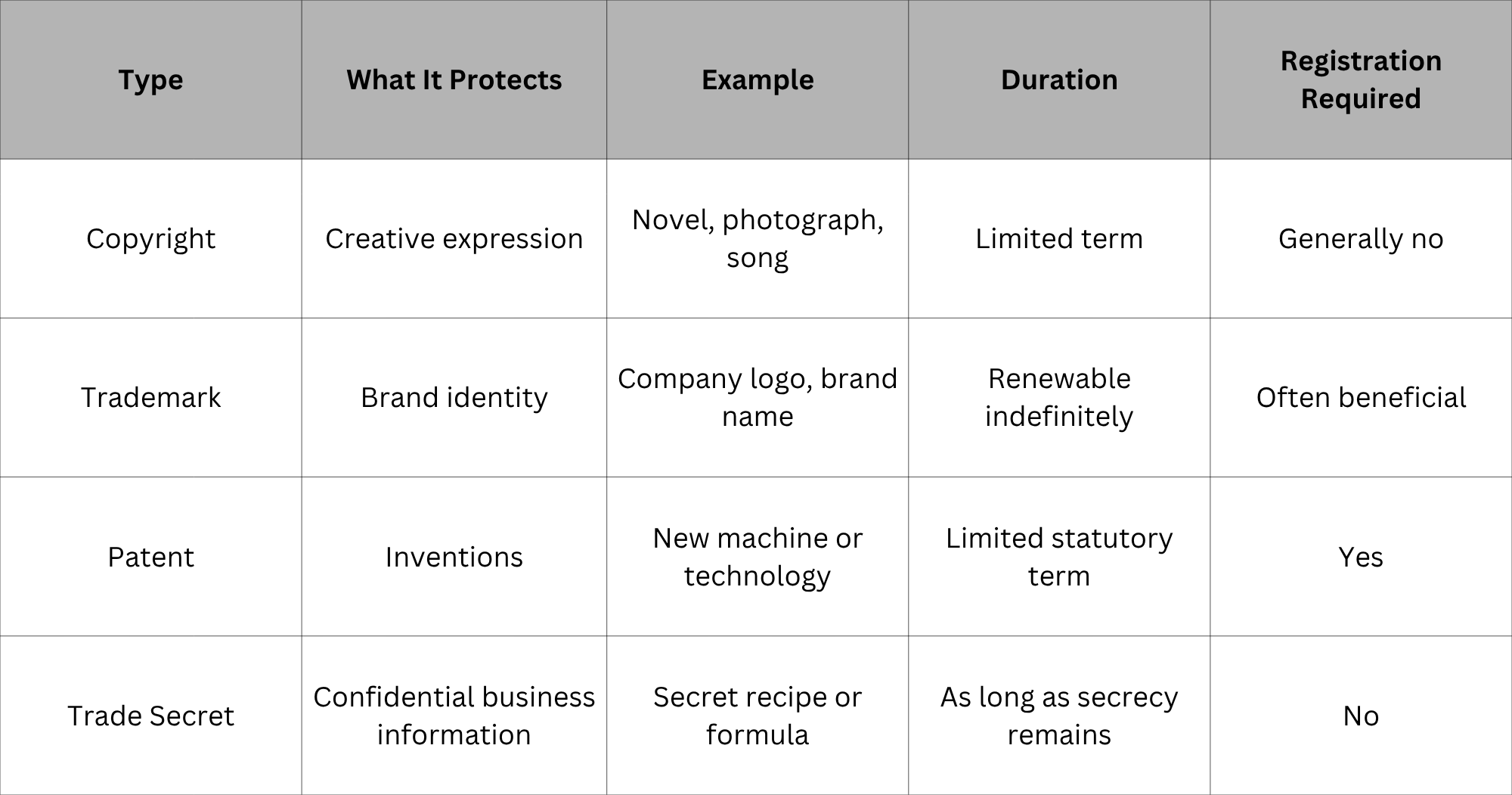
Copyright is just one area of intellectual property law. Because intellectual property is comprised of multiple legal systems, copyright is frequently confused with trademarks, patents, and trade secrets. Understanding the differences is critical because each type of protection serves a unique purpose.
1. Copyright
Copyright protects creative expression. It applies to literary works, music, films, photographs, software, artwork, and numerous other forms of original content. The focus is not on the underlying idea but on the creator's unique expression of that idea.
2 . Trademark
Trademark law serves a different purpose. Rather than protecting creative expression, it protects symbols that identify the source of goods or services. Business names, logos, product names, and slogans often fall within trademark law.
For example, a company logo may possess artistic qualities, but its primary legal protection often comes from trademark law because it identifies the source of products or services.
3. Patent
Patent law protects inventions and technological innovations. Unlike copyright, which arises automatically in many situations, patents typically require formal application and examination procedures. A patent may protect a new machine, manufacturing process, chemical composition, or technological invention.
4. Trade Secret
Trade secrets protect confidential information that derives value from remaining secret. Manufacturing techniques, formulas, recipes, algorithms, and business processes may qualify as trade secrets if reasonable efforts are made to maintain confidentiality.
What Can Be Copyrighted?
Copyright protects a remarkably broad range of creative works. Although the categories vary slightly between jurisdictions, most copyright systems recognize several major classes of protected works.
1. Literary Works
Literary works are one of the oldest and most diverse categories of copyright protection. Despite the name, literary works include more than just novels and poems. The category encompasses nearly any original written expression. Essays, research papers, and books are some common examples.
The protection extends beyond the mere subject matter. Copyright protects the author's original wording, arrangement, structure, style, and creative expression. Two authors may write about the same topic, discuss the same historical event, or explain the same scientific concept. What copyright protects is the unique manner in which each author communicates that information.
Consider a travel writer describing a journey through Paris. Other writers remain free to discuss Paris, its landmarks, culture, and history. However, they cannot simply reproduce the author's original descriptions, narrative style, observations, and written passages without permission.
2. Musical Works and Sound Recordings
Music is an interesting example because multiple copyrights can exist in a single song.
A musical composition may consist of a melody, lyrics, musical arrangement, harmonic structure, and other elements. In contrast, a sound recording refers to the recorded performance.
This distinction often surprises people. A songwriter who composes lyrics and melody may own rights in the composition itself. Meanwhile, a recording company or performer may own separate rights in the recorded version of that composition.
For example, two artists may perform the same song. The underlying composition remains the same, but each recording may possess its own copyright protection because each recorded performance constitutes a separate creative work.
3. Photographs and Visual Art
In the digital era, photography and visual art have grown in importance as categories of copyrighted works.
Examples include photographs, paintings, illustrations, digital art, graphic designs, drawings, sculptures, and concept art.
People sometimes assume that photographs merely capture reality and therefore involve little creativity. In reality, photographers make numerous creative decisions involving composition, perspective, timing, framing, lighting, color balance, focus, and subject selection.
A photographer who captures a dramatic landscape image at sunrise is not obtaining ownership of the mountain or sunrise itself. Rather, copyright protects the photographer's original visual expression embodied in that specific photograph.
4. Motion Pictures and Video Content
Motion pictures are among the most complex copyrighted works because they frequently incorporate multiple creative elements into a single production.
Examples include feature films, television shows, documentaries, online courses, streaming content, and YouTube videos.
A single motion picture may contain numerous protected components, including scripts, dialogue, music, sound recordings, visual effects, cinematography, editing, artwork, and graphic design.
As a result, film production frequently involves multiple creators, contracts, licenses, and rights holders working together to create a finished work.
5. Computer Software and Source Code
Software has become one of the most economically significant types of copyrighted content.
Examples include mobile apps, desktop software, video games, websites, operating systems, enterprise software, and artificial intelligence tools.
Copyright protects source code written by developers because it is a form of literary expression. The protection is limited to the specific code itself, rather than the abstract functionality or concept underlying the software.
This distinction is important. Copyright generally does not prevent competitors from creating software that performs similar functions. What it prevents is the unauthorized copying of original source code and protected expression.
6. Architectural Works
Architecture combines functional requirements and artistic expression. Modern copyright systems frequently classify architectural works as protectable creative works.
Examples include building designs, architectural drawings, blueprints, and structural plans.
Protection may be extended to specific original design elements, while acknowledging that functional and engineering requirements may involve separate legal considerations.
7. Choreographic Works
Choreography is another area that many people overlook.
Examples include dance routines, ballet performances, stage choreography, and performance sequences. Choreography may be eligible for copyright protection if it contains original creative expression fixed in a tangible form, such as notation or video recording.
What Cannot Be Copyrighted?
Understanding copyright limitations is just as important as understanding copyright protection itself.
1. Ideas and Concepts
The principle that copyright protects expression rather than ideas is one of the foundations of copyright law.
Ideas are considered part of the common intellectual resources available to everyone. If ideas themselves could be copyrighted, creative development and innovation would become severely restricted.
For example, nobody can own the general idea of a romance novel, a detective story, a cooking show, or a mobile messaging application. What may be protected is the specific expression used to develop those ideas.
2. Facts and Information
Facts belong to the public domain of knowledge. Some examples of facts and information include Historical events, scientific facts, mathematical principles, geographical data and statistical information
An author may own copyright in a book discussing historical events, but the underlying facts remain available for everyone to use.
3. Methods, Systems and Procedures
In general, operational processes, systems, methods, and procedures are not protected by copyright.
Manufacturing processes, scientific methods, business strategies, and mathematical formulas are a few examples. Although copyright is typically not the best method, other types of intellectual property protection may occasionally be applicable.
4. Names, Titles and Short Phrases
Individual words, names, titles, and short phrases generally fall outside copyright protection.
Examples include company names, product names, book titles, and short slogans. These items may often be protected through trademark law rather than copyright law.
Copyright Notice Examples
Although copyright protection generally exists without formal notice, copyright notices continue to play an important practical role.
Historically, copyright notices were often required under certain legal systems. Today, they primarily serve to identify ownership, provide information to users, and discourage unauthorized use.
Anatomy of a Copyright Notice
A typical notice contains several components.
1. The Copyright Symbol
The symbol © is widely recognized as indicating a copyright claim.
2. The Publication Year
The year often identifies when the work was first published.
3. The Owner's Name
The owner may be an individual, company, organization, or other legal entity.
4. Rights Statement
Many notices include a phrase such as "All Rights Reserved" to emphasize that rights are being retained.
Copyright Notice Examples
Website footer:
© 2026 Example Media Ltd. All Rights Reserved.
Author notice:
© 2026 John Smith. All Rights Reserved.
Software notice:
Copyright © 2026 ABC Software Solutions.
Where Copyright Notices Are Commonly Used
Copyright notices frequently appear in website footers, mobile applications, printed books, e-books, PDFs, online courses, email newsletters, software interfaces, and digital downloads. Many major websites place copyright notices on every page because doing so helps establish clear ownership information.
Copyright Infringement Examples
Copyright infringement occurs when protected material is used without authorization in a manner that violates the exclusive rights of the copyright owner.
The concept may appear simple, but infringement disputes often involve complex questions regarding ownership, permissions, licensing, fair use, and substantial similarity.
1. Copying Articles and Blog Content
One of the most common forms of online infringement involves copying articles from websites and republishing them elsewhere without authorization.
Because digital content can be duplicated almost instantly, content theft remains a persistent problem for publishers, bloggers, journalists, and businesses.
2. Using Images Without Permission
Another frequent example involves photographs and visual content.
A business owner may discover an attractive image online and place it on a company website without obtaining permission. Although the image is publicly visible, visibility does not mean it is free to use.
Photographers regularly enforce their rights against unauthorized image usage.
3. Uploading Movies and Television Programs
Unauthorized distribution of films, television programs, and streaming content has long been a significant area of copyright enforcement.
Uploading copyrighted entertainment content without authorization may constitute infringement because it interferes with the rights of copyright owners to distribute and monetize their works.
4. Sharing Paid Educational Content
Online education has created new infringement challenges.
Examples include:
- Sharing paid courses
- Redistributing subscription content
- Uploading premium educational materials
- Copying proprietary learning resources
Creators who invest substantial effort into developing educational materials often rely on copyright protection to safeguard their work.
5. Copying Software Code
Software infringement may occur when developers copy protected source code from another program without authorization.
Although software ideas and functionality may not themselves be protected by copyright, the actual code used to implement those ideas may receive protection.
Fair Use Examples
Fair use exists because copyright law seeks to balance the interests of creators with the broader interests of society.
Without limitations and exceptions, copyright could interfere with education, criticism, journalism, research, and public discussion.
1 . Educational Uses
Educational institutions frequently rely upon fair use principles when teaching students.
For example, a professor discussing a novel may display short excerpts for classroom analysis. The purpose is educational rather than substituting for the original work.
2. News Reporting
Journalists often quote portions of speeches, documents, books, or other materials when reporting events of public importance.
Such uses may support public understanding and informed discussion.
3. Commentary and Criticism
Critics frequently reference copyrighted works while evaluating them.
A film reviewer may discuss scenes from a movie. A book reviewer may quote short passages. A music critic may analyze lyrics or performances.
These activities often serve commentary and criticism rather than simple reproduction.
4. Parody
Parody occupies a unique position because it frequently imitates existing works while commenting upon them.
The transformative nature of parody often plays an important role in legal analysis.
5. Public Domain Examples
The public domain consists of works that are not protected by copyright.
This status may arise because copyright has expired, protection was never available, or rights were intentionally dedicated to the public.
Public domain materials often form an important part of humanity's cultural heritage.
Some examples could be:
- Very old literary works
- Historical documents
- Certain government publications
- Expired artistic works
Once a work enters the public domain, it may generally be copied, distributed, adapted, translated, and reused without obtaining permission.
Creative Commons Examples
Creative Commons licenses provide creators with a flexible method of granting permissions to the public.
Rather than reserving all rights, creators may choose to reserve only certain rights.
1 . CC BY
Users may generally reuse the work if attribution is provided.
2. CC BY-SA
Derivative works must generally be shared under similar terms.
3. CC BY-NC
Reuse is generally restricted to non-commercial contexts.
4. CC0
The creator waives rights to the greatest extent possible, effectively placing the work into the public domain.
Creative Commons licensing has become increasingly important for educators, researchers, artists, photographers, and online publishers seeking to share content while retaining certain conditions.
AI and Copyright in 2026
Artificial intelligence has become one of the most important and rapidly evolving areas of copyright law.
Generative AI systems can now produce articles, images, software code, music, voice recordings, animations, and videos that may resemble human-created works. As these technologies become more sophisticated, they continue to raise significant legal and philosophical questions regarding authorship, ownership, originality, and infringement.
AI Training Data Disputes
Many copyright controversies focus on the materials used to train artificial intelligence systems.
Large datasets frequently contain enormous collections of text, images, audio recordings, books, websites, and other forms of content. Rights holders have questioned whether copyrighted works may be used for training purposes without permission.
These disputes remain the subject of ongoing litigation and regulatory discussion around the world.
Can AI-Generated Content Be Copyrighted?
One of the most frequently asked questions concerns whether purely AI-generated works qualify for copyright protection.
Many legal systems continue to emphasize human creativity and human authorship as central requirements for copyright protection. Consequently, fully autonomous AI-generated content may face challenges when seeking copyright recognition.
AI-Assisted Versus AI-Generated Works
A useful distinction exists between AI-assisted works and AI-generated works.
AI-assisted works involve meaningful human direction, judgment, creativity, and editorial control. In such situations, the AI system functions more like a tool used by a human creator.
AI-generated works, by contrast, may involve minimal human contribution beyond entering prompts or initiating generation.
The distinction between these categories is likely to remain one of the most important copyright debates of the coming decade.
How to Protect Your Own Work
Creators who invest significant effort into producing original works often wish to strengthen and document their rights.
1. Maintain Records
Creators should preserve drafts, project files, source materials, timestamps, and development records whenever possible.
These materials may help establish authorship and ownership if disputes arise in the future.
2. Use Copyright Notices
Although not usually required, notices remain useful because they clearly communicate ownership information to users.
3. Monitor Unauthorized Use
Regular monitoring may help creators identify unauthorized reproductions of valuable content.
4. Consider Registration
Where registration systems exist, registration may provide procedural and legal advantages, particularly in enforcement actions.
5. Copyright Notice Template
Individual creator:
© [Year] [Creator Name]. All Rights Reserved.
Website:
© [Year] [Website Name]. All Rights Reserved.
Business:
© [Year] [Company Name]. All Rights Reserved.
Conclusion
Copyright remains one of the foundational legal mechanisms governing creative expression in modern society. It influences literature, journalism, music, photography, filmmaking, software development, education, publishing, scientific communication, and countless other fields. Although the principles underlying copyright have existed for centuries, the digital age has transformed the ways in which creative works are produced, distributed, copied, and consumed.
Understanding what copyright protects and what it does not protect is essential for creators, businesses, educators, students, researchers, and internet users alike. The distinction between ideas and expression, the role of copyright notices, the concept of infringement, the importance of fair use, and the operation of the public domain all contribute to a more complete understanding of the copyright system.
As artificial intelligence, digital publishing, global communication networks, and emerging technologies continue to reshape the creative landscape, copyright law will remain a subject of ongoing discussion and evolution. For creators, understanding copyright is not merely a legal concern; it is an important part of protecting creative effort, preserving ownership, and participating responsibly in the exchange of knowledge and culture.
Frequently Asked Questions
1. What is an example of a copyright?
A copyright example may include a novel written by an author, a photograph taken by a professional photographer, a song composed by a musician, a software application developed by programmers, or a documentary produced by filmmakers. Each of these works involves original creative expression that may qualify for copyright protection.
2. What can and cannot be copyrighted?
Copyright can protect original literary works, music, films, artwork, photographs, software, and numerous other creative works. However, copyright generally does not protect ideas, facts, systems, procedures, methods, discoveries, names, or short phrases.
3. Do I need a copyright notice on my website?
In most jurisdictions, copyright protection exists even without a notice. However, a notice can help identify ownership, discourage unauthorized copying, and provide useful information to visitors regarding rights and permissions.
4. What is an example of copyright infringement?
A common example is copying an article from another website and republishing it without permission. Other examples include using photographs without authorization, distributing copyrighted films, sharing premium educational content, and copying software code.
5. Is fair use legal?
Yes. Fair use is a recognized legal doctrine in many jurisdictions. It exists to permit certain socially beneficial uses of copyrighted material, including criticism, commentary, education, journalism, scholarship, and research.
6. Can AI-generated content be copyrighted?
The answer depends upon the applicable legal system and the extent of human involvement. Many copyright authorities continue to emphasize meaningful human authorship when determining whether a work qualifies for copyright protection.