




Subscribe to ConsentBit Newsletter
Cookie
Cookie Notices vs Consent

19
January
2026
31
July
2026

As privacy regulations such as GDPR, CCPA/CPRA, LGPD, and DPDP continue to shape how websites handle user data, terms like cookie consent and cookie notice are often used interchangeably. However, they are not the same thing, and confusing the two can lead to serious compliance issues.
Understanding the difference between a cookie notice and cookie consent is essential for website owners, designers, and product teams who want to remain legally compliant while maintaining user trust. This guide explains what each term means, how they function, and when each is required.
What Is a Cookie Notice?
A cookie notice is an informational message displayed on a website to notify users that cookies are being used. Its primary purpose is transparency rather than permission. A cookie notice tells visitors that the website uses cookies and often links to a cookie policy or privacy policy where more details are provided.
In its simplest form, a cookie notice may appear as a small banner or message stating that the site uses cookies to improve functionality or user experience. In some jurisdictions and use cases, particularly when only strictly necessary cookies are used, a cookie notice alone may be sufficient to meet legal requirements.
A cookie notice typically focuses on:
- Informing users that cookies are present
- Explaining, at a high level, why cookies are used
- Directing users to further documentation
Importantly, a cookie notice does not require the user to take action. It does not ask users to accept or reject cookies, nor does it block cookies from being placed. Cookies may already be active when the notice is shown.
When Is a Cookie Notice Used?
A cookie notice is generally used when a website relies only on strictly necessary cookies. These are cookies required for core website functionality, such as security, session management, or load balancing. Because these cookies do not track users for analytics, advertising, or personalization purposes, most privacy laws do not require explicit consent for them.
In these cases, informing users through a cookie notice fulfills transparency obligations without interrupting the user experience. However, the moment a website uses analytics, marketing pixels, or third-party tracking tools, a cookie notice alone becomes insufficient under most regulations.
What Is Cookie Consent?
Cookie consent is the process of actively obtaining user permission before placing or activating non-essential cookies. Unlike a cookie notice, cookie consent is not just informational, it is action-based and enforceable.
A cookie consent mechanism requires the website to:
- Ask users for permission before setting certain cookies
- Allow users to accept or reject cookies
- Respect the user’s choice technically and legally
Cookie consent is mandatory under regulations like GDPR when a website uses non-essential cookies such as analytics, advertising, retargeting, or personalization cookies. Consent must be freely given, informed, specific, and unambiguous.
In practice, cookie consent is implemented through a banner or modal that appears on first visit and blocks non-essential cookies until the user makes a choice.
Key Elements of Cookie Consent
A compliant cookie consent setup includes several critical components. First, cookies must be blocked by default until the user gives consent. Second, users must be offered real choices, such as accepting all cookies, rejecting non-essential cookies, or managing preferences by category. Third, consent decisions must be stored securely so they can be respected on future visits. Finally, users must be able to withdraw or change consent at any time.
Unlike a cookie notice, cookie consent directly controls whether tracking technologies are allowed to operate.
Why Cookie Consent Is Legally Required
Privacy laws are designed to give users control over their personal data. Cookies that track behavior, analyze usage, or enable targeted advertising are considered personal data processing activities. Under GDPR and similar laws, processing this data without consent is unlawful.
Cookie consent ensures that:
- Users understand what data is collected and why
- Users actively agree before tracking begins
- Website owners can demonstrate lawful data processing
Failing to implement proper cookie consent can lead to fines, enforcement actions, and reputational damage.
Cookie Notice vs Cookie Consent: The Core Differences
Although both relate to cookies and privacy, the difference between a cookie notice and cookie consent is fundamental.
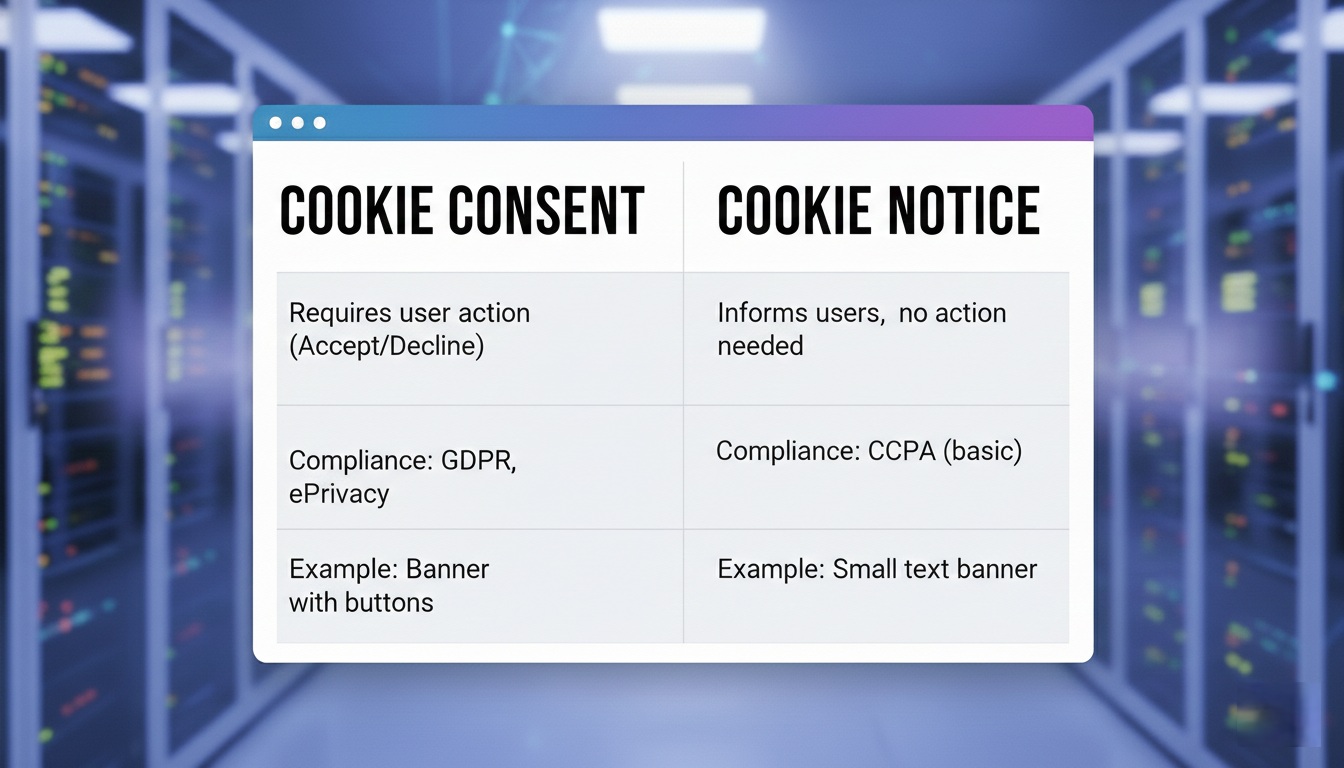
A cookie notice is informational, while cookie consent is permission-based. A cookie notice tells users that cookies exist, whereas cookie consent asks users whether certain cookies may be used at all. Cookie notices do not block cookies, but cookie consent mechanisms must technically prevent cookies from firing until consent is granted.
From a legal perspective, a cookie notice supports transparency, while cookie consent enables lawful data processing. Using a cookie notice when consent is required is a common compliance mistake.
You may be interested in reading our blog on what is a cookie banner?
Comparison Table: Cookie Consent vs Cookie Notice
Here is a quick comparison:
Common Misconceptions
A common misconception is that displaying a banner that says “By using this site, you accept cookies” qualifies as consent. Under GDPR, this is not valid consent because it does not require a clear affirmative action. Another misunderstanding is assuming that a cookie notice is enough when analytics tools are used. In reality, analytics cookies almost always require consent in the EU and many other regions.
Some websites also believe that hiding cookies behind a privacy policy link fulfills legal requirements. Transparency alone does not replace consent when consent is required.
Which One Does Your Website Need?
If your website uses only strictly necessary cookies, a cookie notice combined with a clear cookie policy may be sufficient. However, if your website uses analytics, marketing pixels, advertising tools, or third-party embeds, you need full cookie consent with script blocking and preference management.
For most modern websites, especially those focused on growth, marketing, or performance tracking, cookie consent, not just a cookie notice is required.
Best Practice: Combining Both Correctly
In practice, a compliant setup combines both concepts. A cookie consent banner serves as the user interface for consent, while also acting as a notice by explaining cookie usage. Behind the scenes, scripts are blocked until consent is given, and preferences are stored and respected.
This approach satisfies both transparency and consent requirements and aligns with modern privacy expectations.
Conclusion
Cookie notice and cookie consent are related but fundamentally different concepts. A cookie notice informs users that cookies are being used, while cookie consent actively gives users control over whether non-essential cookies can be placed. Understanding and implementing the correct approach is essential for legal compliance, user trust, and long-term sustainability.
As privacy laws continue to change and enforcement increases, relying on a cookie notice alone is no longer sufficient for most websites. Proper cookie consent ensures that data collection is lawful, transparent, and respectful of user rights. If you would like to get more details on these, do not hesitate to contact us. We are always here to help.