




Subscribe to ConsentBit Newsletter
Cookie
Consent Mode v2 After June 15, 2026: What Changed and Why Your Data Now Depends on Your CMP

30
July
2026

TL;DR
1 . On June 15, 2026, Google retired Google Signals as a control over the flow of data from GA4 into Google Ads.
2. From that date, the ad_storage signal your CMP sends is the only thing that decides whether advertising data reaches Google Ads — there's no fallback.
3. If your consent banner is misconfigured and doesn't send ad_storage=granted when it should, your conversion data silently stops.
4. Your CMP just became a single point of failure for your ad performance. Audit it now.
What changed on June 15, 2026? (The short answer)
Google removed Google Signals as a fallback control over whether GA4 data flows into Google Ads for advertising use.
Before, Google Signals could act as a secondary path — a way advertising data still reached Google Ads even when your consent signals were incomplete or imperfect. That safety net is gone. From June 15, 2026:
- ad_storage exclusively controls whether advertising data flows into Google Ads.
- ad_storage is a Consent Mode v2 signal your CMP sends — set to granted or denied based on user consent.
- Consent Mode is now the single control between Analytics and Google Ads.
In plain terms: whatever your cookie banner sends is now the whole story. Get the signal wrong, and there's nothing behind it to catch the data.
Before vs. after June 15: quick comparison
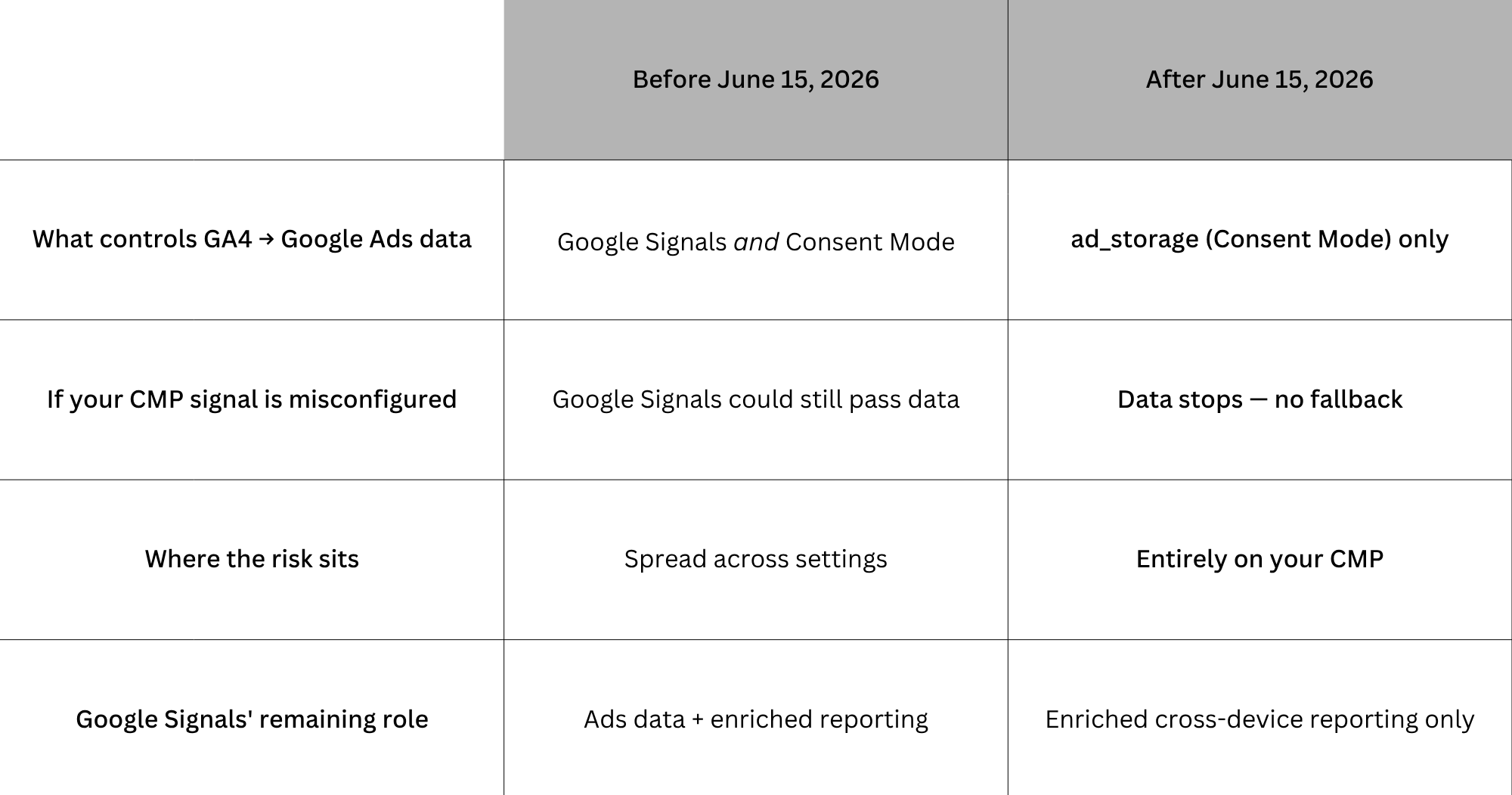
That third row is the whole story: the risk moved onto your CMP.
What Google actually retired
Let's be precise, because the headlines oversimplify it.
- Google Signals isn't fully "dead." It still governs enriched cross-device reporting and demographics in GA4.
- What it lost is its role as a control over the advertising data flow into Google Ads.
- What replaced it: ad_storage, the Consent Mode v2 parameter, is now the sole gatekeeper for that ads data.
This is a continuation of the direction Google set when it made Consent Mode v2 mandatory for EEA/UK advertising in 2024 (when ad_storage began auto-mapping to ad_user_data). June 15, 2026 is the moment Consent Mode stopped being one control and became the control.
Why your CMP is now the single point of failure
Here's why this is bigger than a technical footnote.
- Your CMP generates the ad_storage signal. When a user accepts, your CMP is supposed to update Consent Mode to granted. When they decline, denied.
- If that signal is wrong, incomplete, or fires late, Google Ads now receives nothing for that user — and there's no Signals fallback to soften the loss.
- The failure is invisible. Your campaigns look unchanged. Your budget is intact. Your banner still pops up. But your conversion and audience data is quietly bleeding out.
A single point of failure isn't a problem when it works. It's a catastrophe when it fails silently — because by the time you notice, you've already lost weeks of data and optimization signal.
The silent failure: how a misconfigured banner kills your ad data
This is the part that should make you check your setup today.
Marketers reporting on the change describe the same pattern: a CMP update or a small misconfiguration, and conversions collapse overnight — while everything looks fine. One practitioner described a client who lost 90% of tracked conversions overnight after a CMP update — campaigns unchanged, budget intact, data simply gone.
On the Google Tag Manager forums, the June 15 threads are full of the same symptoms: consent "granted" but tags not firing, conversions not tracking after a consent change, Consent Mode timing issues where the signal initializes too late. The common thread is always the same: the CMP and the consent signal, not the ad account.
The scary part isn't that things break. It's that they break quietly. Ad platforms keep spending. Dashboards keep showing some numbers. Nobody gets an alert. The gap only shows up when performance mysteriously "declines" — and the real cause is a consent signal that stopped saying granted.
How to audit your Consent Mode v2 setup
Run this checklist — ideally today, not next quarter.
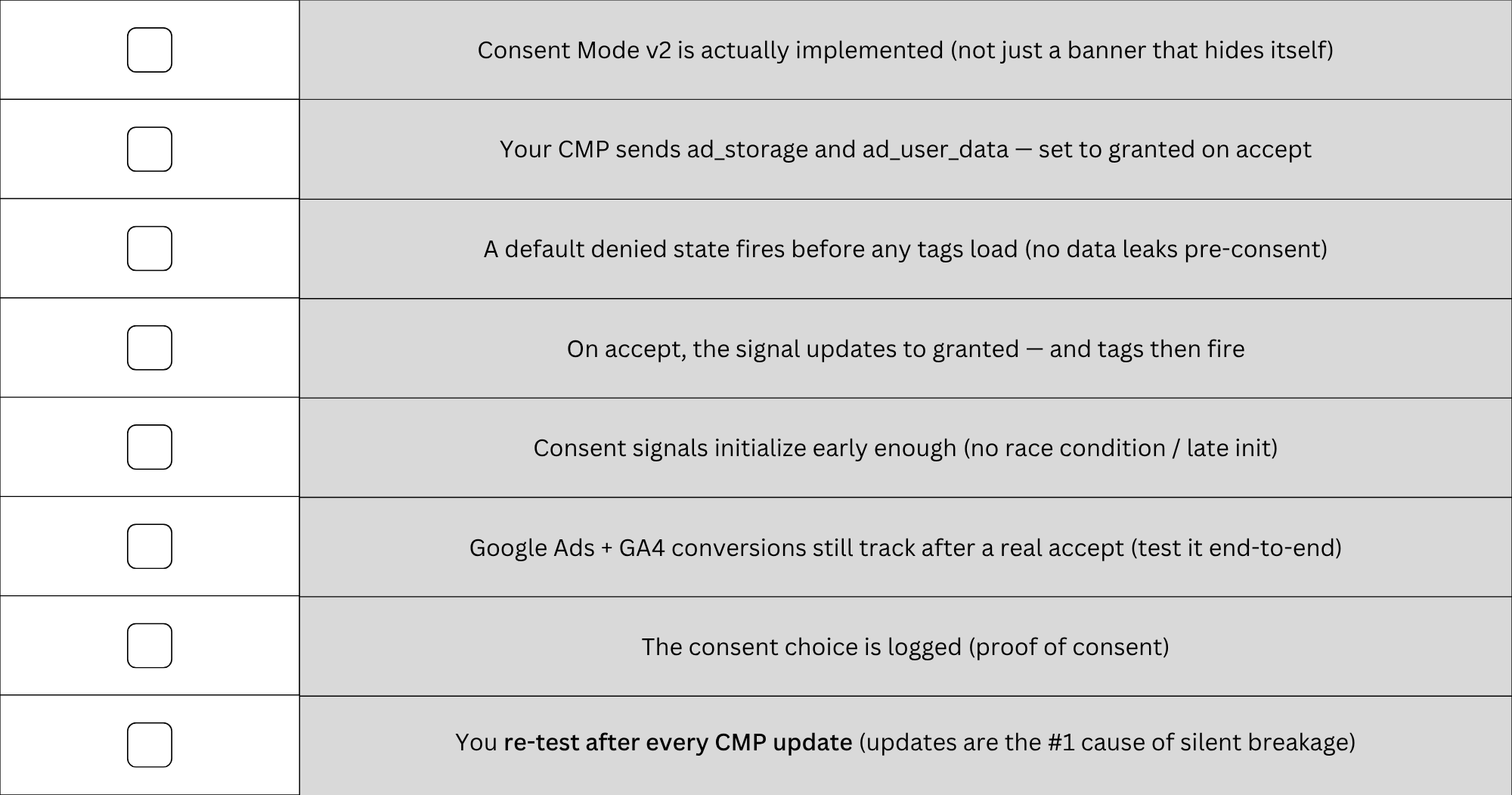
If you can't confidently tick every box, assume you're losing data.
What a correct setup looks like
The fix isn't complicated — it's about doing the signal correctly and verifying it.
- Block non-essential scripts by default and fire a
deniedConsent Mode state before anything loads. - On consent, update
ad_storageandad_user_datatograntedimmediately and reliably — so Google Ads receives the signal it now depends on entirely. - Confirm the timing so consent initializes before your tags, not after.
- Log every choice so you have proof of consent and a record you can audit.
- Re-test after every change to the CMP, GTM, or site.
This is exactly where a properly built CMP earns its keep: ConsentBit blocks scripts before consent, sends the correct Consent Mode v2 signals (ad_storage / ad_user_data) the moment a user accepts, and logs the choice — so the single control Google now relies on is actually saying the right thing. No tool can promise "100% compliant," and this isn't legal advice — but a correctly configured CMP is the difference between data that flows and data that silently disappears.
What ignoring this costs you
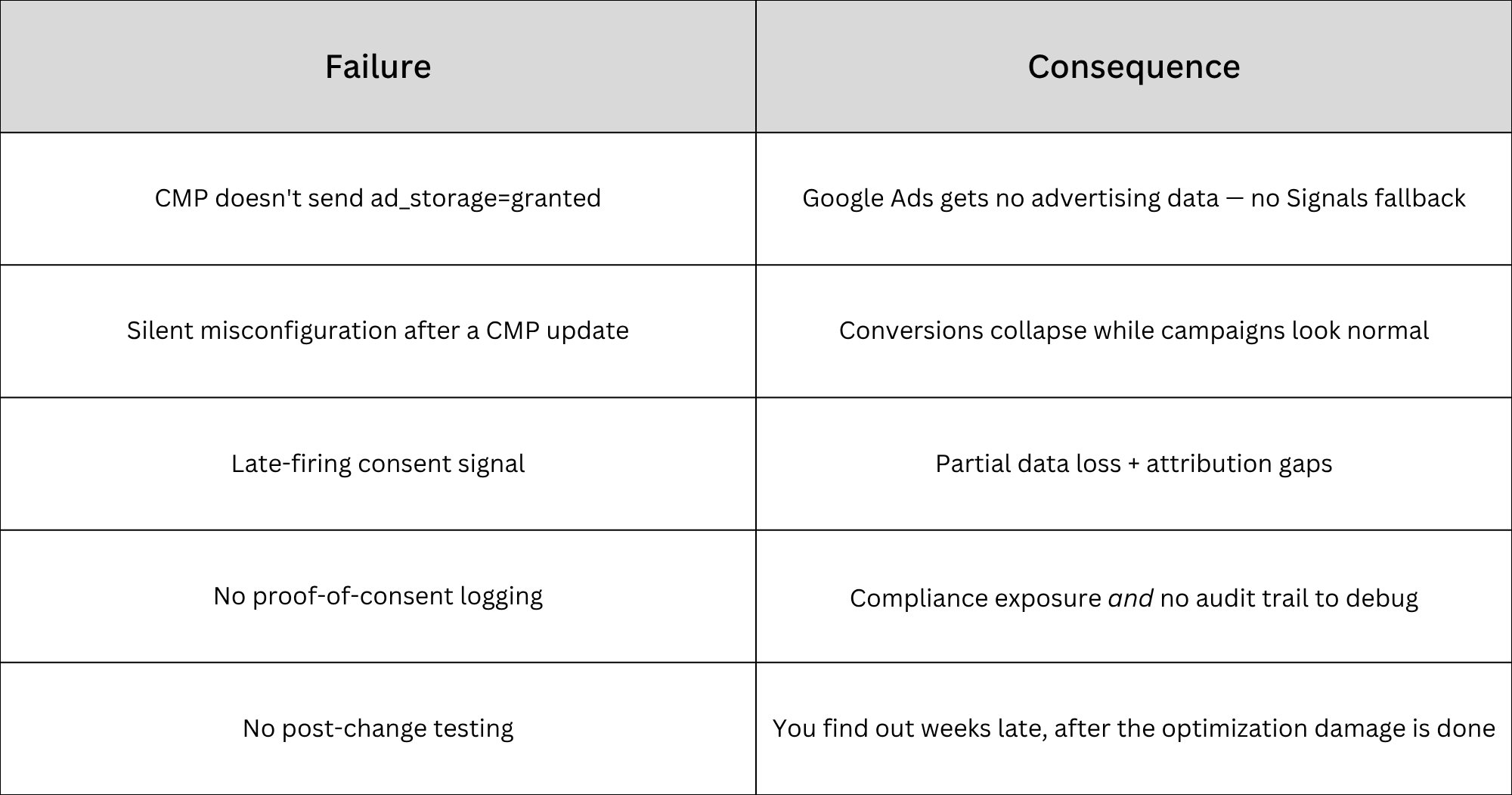
The cost isn't just compliance risk. It's wasted ad spend optimized on broken data.
FAQs
1 . What exactly changed with Consent Mode on June 15, 2026?
Google retired Google Signals as a control over the flow of GA4 data into Google Ads. From that date, the ad_storage Consent Mode signal — sent by your CMP — is the sole control over whether advertising data reaches Google Ads.
2. What is happening with the Google Signals deprecation?
No. Google Signals still governs enriched cross-device reporting and demographics in GA4. What it lost is its role as a control over the advertising data flow into Google Ads.
3. Why does my CMP matter more now?
Because there's no fallback anymore. Your CMP generates the ad_storage signal, and that signal alone decides whether ad data flows. If it's misconfigured, data stops — silently.
4. How do I know if my setup is broken?
Test a real consent acceptance end-to-end and confirm Google Ads and GA4 conversions still track. Watch for "granted but not firing," late-initializing consent, or conversion drops after a CMP update.
5. Do I need Consent Mode v2 if I serve EEA/UK traffic?
Yes. Consent Mode v2 has been required for Google advertising features in the EEA/UK since 2024, and after June 15, 2026 its ad_storage signal is the single control over ad data. (This is not legal advice.)
6. Can a CMP guarantee I won't lose data or stay compliant?
No tool can guarantee compliance or zero data loss. What a correctly configured CMP does is send the right signals reliably and log the choice — dramatically lowering the risk of silent failure.
Close
June 15, 2026 didn't just tweak a setting — it moved the entire weight of your Google Ads data onto one thing: the signal your cookie banner sends. When that's your single point of failure, "we have a banner" isn't good enough. You need a CMP that sends the right Consent Mode v2 signals, blocks scripts before consent, and logs every choice — and you need to test it after every change.
Not sure what your banner is actually sending to Google right now? Run a quick check with ConsentBit — we'll help you confirm your Consent Mode v2 signals are firing correctly, so your ad data doesn't disappear without warning.